
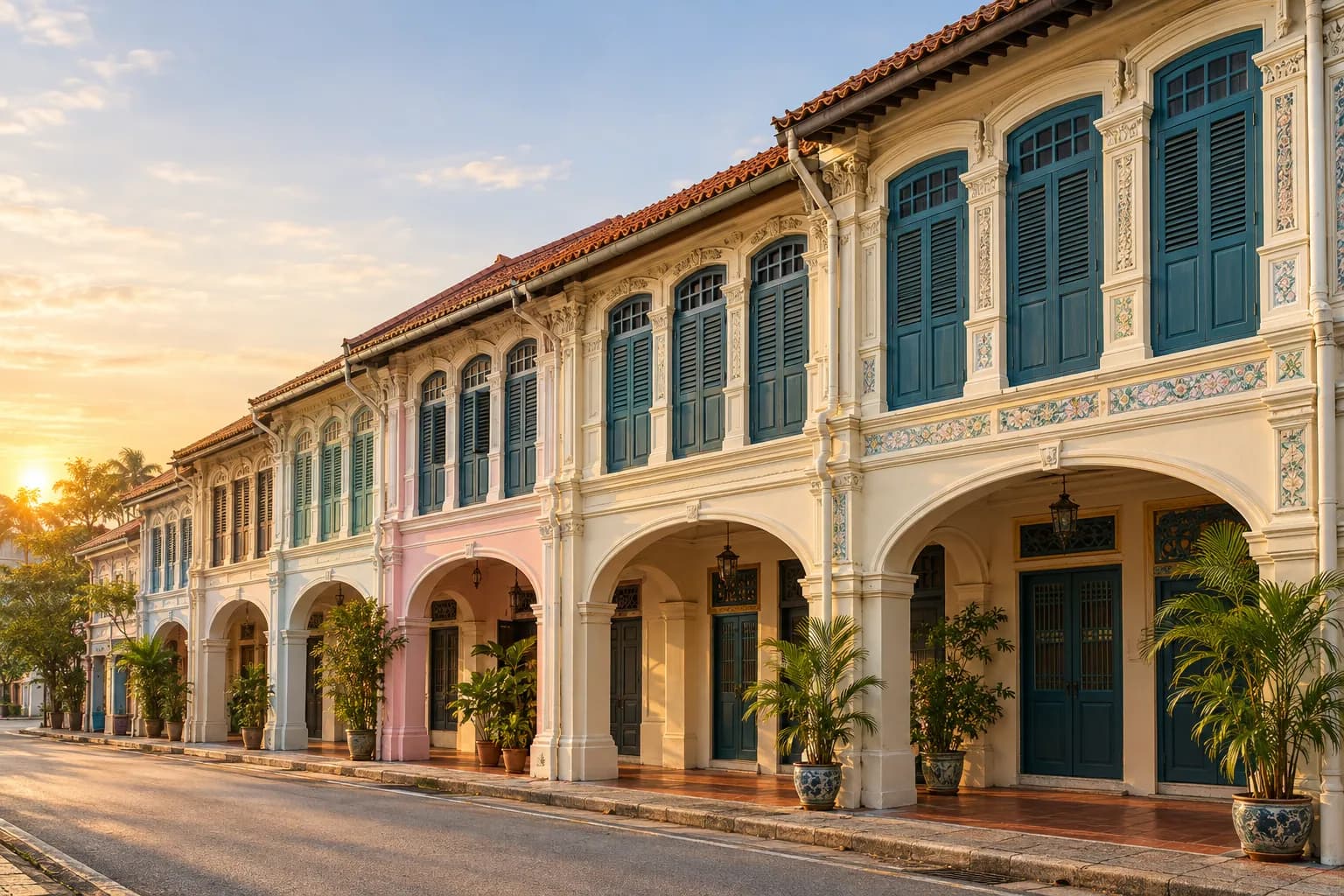
Searchers looking for an HDB shophouse are rarely looking for the same product as a Club Street or Telok Ayer conservation terrace. HDB commercial premises — including older shophouse-style shops in heartland and city-fringe estates — are allocated, leased, and sometimes sold under Housing & Development Board commercial rules. Private URA conservation shophouses sit on private title, a different stamp-duty conversation, and a different restoration duty.
This hub is written for operators, owner-occupiers, and investors who need a clean map of HDB shophouse rental, HDB shophouse for sale, living-quarters questions, and change-of-use caveats — without treating HDB stock as a cheaper version of a conservation trophy. We do not quote invented asking prices or tender results here. Confirm live terms against current HDB commercial circulars and, where title has already passed into private hands, against the instrument and counsel.
1. What an HDB shophouse actually is
In everyday Singapore English, “HDB shophouse” usually means a commercial unit in an HDB-developed or HDB-managed block that looks and trades like a shop-house: ground-floor frontage, an upper floor that may be storage, office, or approved living quarters, and a neighbourhood catchment rather than a conservation high street. Some sit in older estates; some sit near conserved precincts. Visual kinship with a Peranakan terrace does not make the title, landlord, or use regime the same.
HDB commercial premises are typically let or sold as commercial products. Occupancy of any living quarters, the permitted trade, and any later change of use are controlled first by HDB’s commercial terms and, where planning permission is required, by URA. That is a different stack from a privately titled conservation shophouse, where URA conservation grade, Master Plan zoning, and IRAS stamp-duty classification dominate the first week of diligence.
2. HDB shophouses versus private conservation shophouses
Use this comparison before you fall in love with a façade photograph. Neighbourhood colour on Jalan Besar, Geylang, or the east-side lanes around Joo Chiat can include both HDB commercial shops and private conservation lots on the same walking loop.
| Dimension | HDB shophouse / HDB commercial | Private conservation shophouse |
|---|---|---|
| Landlord / title | HDB as landlord or original vendor; later private owners still carry HDB commercial covenants in many cases | Private freehold or leasehold title; State lease covenants where applicable |
| Primary rulebook | HDB commercial tenancy or sale conditions; living-quarters and trade approvals | URA conservation grade, Master Plan zoning, private lease |
| Typical pathway | HDB commercial rental portal / HDB sale or assignment of an already-sold unit | Open-market or off-market private sale and lease |
| Living quarters | Only where HDB has approved them; usually ancillary to the trade, not a standalone home | Residential or mixed use only if zoning and approved use allow — see ABSD breakdown |
| Change of use / trade | HDB written approval first; URA and licensing may still apply | URA change of use plus F&B licensing for food trades |
| When to prefer it | Heartland catchment, operator-occupier, approved living quarters above the shop | Streetscape scarcity, long private tenure, institutional zoning clarity |
3. HDB shophouse rental
HDB shophouse rental is the highest-intent path on this hub. Operators typically source vacant HDB commercial units through HDB’s published commercial letting process, or take an assignment / sublet only where the existing tenancy or sale conditions expressly allow it. “A shop that looks available on the street” is not evidence that HDB will accept your trade, your fit-out, or a second occupant upstairs.
Diligence on an HDB lease should include, at minimum:
- The current approved trade and any prohibited trades on the unit
- Whether living quarters exist, who may occupy them, and whether your household or staff arrangement fits the approval
- HDB’s process and timeline for a change of trade or change of use — do not assume a café can replace a provision shop on a handshake
- Fit-out, signage, and kitchen-plant constraints (extraction, grease traps, fire safety) even when the landlord is HDB rather than a private conservation owner
- How the lease treats assignment, early termination, and reinstatement
If you are comparing a private conservation lease instead — Club Street evening trade, a Kampong Glam shopfront, or a Joo Chiat conservation lease — use the shophouse for rent in Singapore hub. That inventory is private title. It does not replace an HDB commercial application.
4. HDB shophouse for sale
An HDB shophouse for sale is a narrower, later-funnel product. HDB periodically offers selected commercial properties for sale. Units that have already been sold may later trade between private parties, still subject to HDB consent, assignment conditions, and the original commercial covenants. That is not the same listing pool as conservation shophouses for sale or freehold shophouses for sale in Singapore.
Buyers should ask, before they spend on surveyors:
- Is the vendor HDB, or a subsequent private owner?
- What written HDB consents are required to complete, to change trade, or to occupy living quarters?
- Is the use fully commercial for stamp-duty purposes, or is there a residential or living-quarters component that changes IRAS treatment? Start with the ABSD commercial versus residential breakdown.
- Can you finance the unit as commercial property, and will the lender accept HDB covenants and any remaining restrictions on assignment?
- If you hoped for a conservation-grade façade premium, is the building actually gazetted — or simply old?
We will not invent tender reserve prices or recent transacted quantum on this page. If you want this desk to watch HDB commercial sale windows or privately held HDB-covenant shops, say so on the form. If you want private CBD or east-side conservation stock, go to the sale hubs instead.
5. Living quarters — high-level rules
Living quarters are one of the reasons people search “HDB shophouse” at all: the idea of trading downstairs and sleeping upstairs. At a high level — and this is not a substitute for the current HDB commercial handbook or your own approval letter — living quarters on HDB commercial premises are typically:
- Ancillary to the approved commercial use, not a separate residential flat you can treat like a resale HDB or a private condo
- Occupancy-restricted — often limited to the operator, specified family members, or other persons named in the approval, rather than open residential letting
- Approval-dependent — presence of a kitchenette or a bed does not prove the quarters are authorised for your household or for a second tenant
- Not a short-stay product by default — visitor accommodation, hostel-style bunking, and unauthorised multiple-occupancy are diligence red flags, not a business model
If the living quarters are the reason you are buying or renting, put that in the first line of your brief. We would rather tell you the approval path is uncertain than let you underwrite a free bedroom that HDB has not allowed. Private live-work arrangements on conservation lots are a different conversation — zoning and ABSD first, then URA conservation constraints on the rooms you hoped to inhabit.
6. Change of use — HDB plus planning, not instead of it
Change of use is a search term that sits beside HDB shophouses for a reason. Operators want to turn a shop into a café, a clinic, or a studio. On HDB commercial premises, HDB’s consent to a change of trade or use is usually the first gate. URA planning permission can still be required when the planning use class changes. Food trades still need the SCDF / NEA / Singapore Food Agency sequence set out in our F&B licensing and change of use guide.
Practical caveats we see on HDB shops as often as on private conservation shells:
- A use that is commercially attractive (late-night F&B, tuition at scale, light manufacturing) may be barred by the block’s approved mix or by estate management
- Kitchen extraction and condensers are no easier when the façade is not gazetted — neighbours and fire safety still govern
- “The last tenant sold chicken rice” is not a transferable licence. Licences attach to operators and premises conditions
- If you need a private conservation F&B corridor instead, look at District 01–02 CBD or District 14–15 East, not an HDB shop that merely photographs well
7. Who this asset suits — and who should walk past
HDB shophouses reward operators who want catchment spend, a defined trade, and — where approved — a disciplined live-work arrangement. They are a poor substitute for investors whose thesis is URA-grade scarcity, 999-year Telok Ayer residual, or freehold conservation.
Walk toward this hub if you are:
- An operator seeking HDB shophouse rental with a named trade
- A buyer watching HDB commercial sale windows or an assignment of an already-sold HDB shop
- A household that needs living quarters above the shop, and is willing to evidence who may occupy
Walk toward the private silos if you are underwriting streetscape scarcity in Tanjong Pagar, Telok Ayer, or a gazetted east-side terrace. Those pages, not this one, carry inventory and conservation playbooks.
8. How to brief Shophouses Singapore
Tell us whether you need HDB shophouse rental, an HDB shophouse for sale, living-quarters confirmation, or a change-of-use feasibility — and name the estate or street if you have one. We will not pretend an HDB shop is a conservation listing, and we will not invent a price to fill a gap. For private inventory alongside this brief, keep shophouses for rent and commercial shophouses for sale open in the next tab.