
East Coast neighbourhood guide
Joo Chiat Shophouses: Peranakan Shophouses for Sale, Rent and Investment
Singapore's best-known Peranakan shophouse district: conservation rules, street-by-street character, uses, rents and what to check before you buy or lease.
Quick answer
What are Joo Chiat shophouses?
Joo Chiat shophouses are two-storey conserved Peranakan terraces and shopfronts in Singapore's east, protected as the Joo Chiat Conservation Area since 1993. They mix residential and commercial use along Joo Chiat Road, Koon Seng Road and nearby lanes, and any change of use or facade work needs URA conservation permission.
Last reviewed 5 November 2026. Market and planning statements are dated and qualitative; verify on the named lot before acting.
Joo Chiat at a glance
- Location
- East Coast, around Joo Chiat Road and Koon Seng Road; postal district 15
- Conservation
- Joo Chiat Conservation Area, gazetted 23 July 1993 (URA)
- Typical styles
- Transitional, Late and Art Deco shophouses; Peranakan decoration
- Typical height
- Mostly two storeys with five-foot ways
- Nearest MRT
- No station on Joo Chiat Road; Thomson-East Coast Line stations at Tanjong Katong and Marine Terrace and East-West Line stations at Eunos and Paya Lebar are the common access points, each a bus ride or a walk away
- Common uses
- Cafés, restaurants, boutiques, studios, offices upstairs, homes
- Related guides
- Joo Chiat area guide, District 14–15 East
- Facts reviewed
- 5 November 2026
Why Joo Chiat is Singapore's reference Peranakan shophouse district
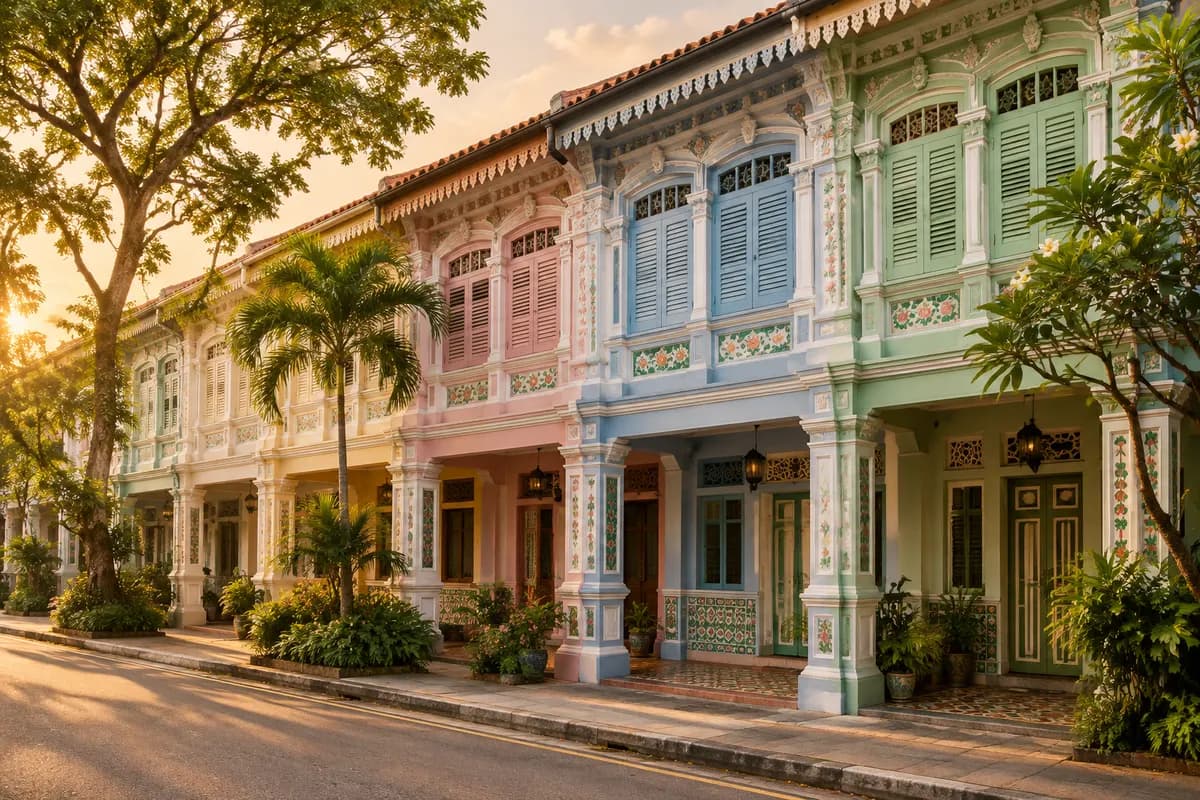
Ask anyone to picture Peranakan shophouses in Singapore and the image is almost always Joo Chiat: pastel facades, glazed floor tiles, carved timber shutters and ornamental plaster in rows that run for blocks. The district is the most intact large-scale example of the late colonial suburban shophouse, built when the east coast was a seaside and plantation belt rather than a city fringe.
That heritage makes Joo Chiat a double-edged market. It is one of the most recognised shophouse addresses for lifestyle tenants and for owner-occupiers who want character, but the same protection that preserves the streetscape also limits what you can change. This page explains the district's history, its conservation framework, the main streets, how the buildings are used, how to read pricing and rents without relying on headline numbers, and what to check before committing.
For the wider picture of the east side, read our District 14–15 East guide and the shorter Joo Chiat area overview. For the conservation process itself, see the URA conservation guidelines buyer manual.
History of Joo Chiat
The area was originally part of a coconut plantation that stretched towards Geylang Serai. Joo Chiat Road is named after Chew Joo Chiat, a landowner often called the King of Katong, whose family developed much of the neighbourhood. As land was subdivided in the early twentieth century, rows of terraces and shophouses went up for a growing community of Peranakan Chinese, Eurasians and Malays.
Peranakan families favoured the seaside east for weekend retreats and later for permanent homes, which is why the decorative vocabulary here is so rich. Eurasian institutions, local churches and small family businesses shaped the neighbourhood's character, and many of those community threads continue today.
Early 1900s
Plantation land is subdivided
Coconut plantation land around Joo Chiat is cut into plots and the first terraces and shophouses appear.
1920s–1930s
Peak shophouse building
Transitional, Late and Art Deco styles spread along Joo Chiat Road and the side streets.
1960s–1980s
Reclamation and redevelopment
East coast reclamation and new housing change the setting, while the old shophouse streets remain.
23 July 1993
Conservation Area gazetted
URA protects Joo Chiat as one of Singapore's early large conservation areas.
2003–2009
More buildings conserved
URA adds further individual buildings in several rounds, including some simple modern buildings and churches.
Peranakan shophouse architecture in Joo Chiat
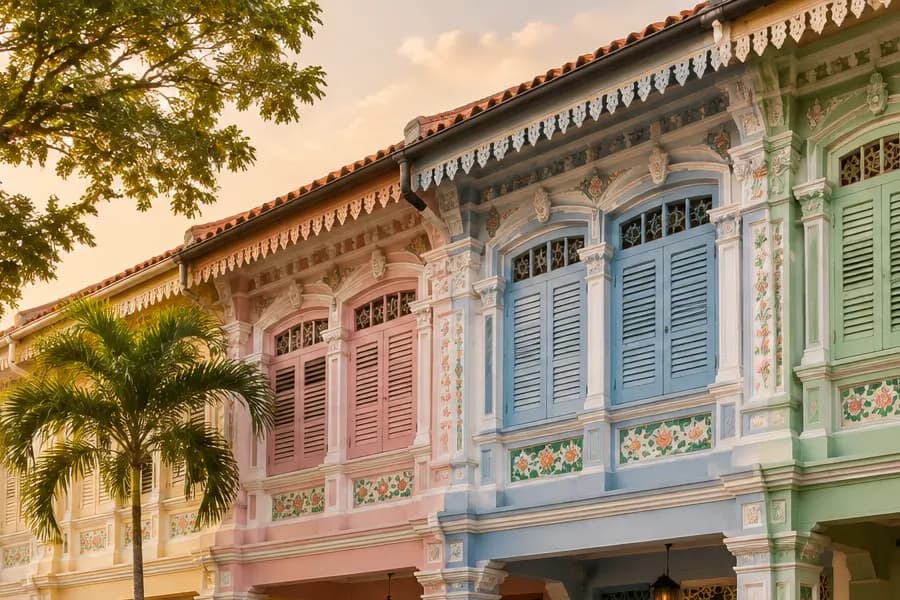
Peranakan shophouses in Joo Chiat are not a single style. URA describes the area as mainly two-storey shophouses and terrace houses in Transitional, Late and Art Deco styles. The Peranakan character comes from the decoration layered on those forms: glazed ceramic tiles in floral and geometric patterns, carved timber panels, louvred shutters, ornate pediments, and plaster figures or fruit and floral motifs on parapets.
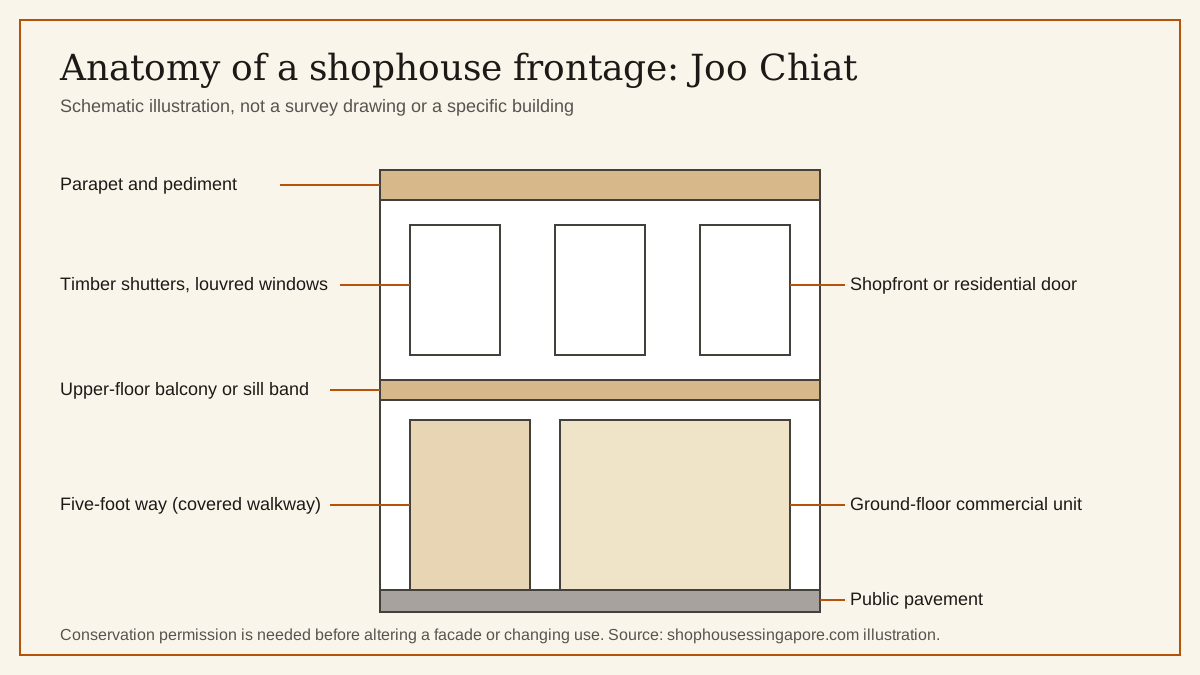
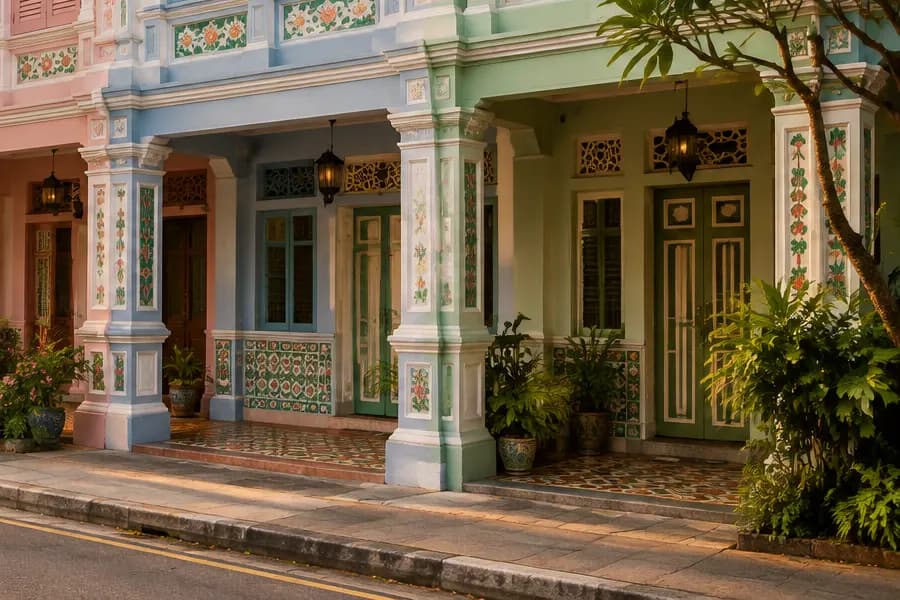
Look for pintu pagar (half-height swing doors), air vents decorated with motifs, and the continuous covered five-foot way that links each unit. Later and Art Deco blocks are plainer and more geometric, with rounded corners and horizontal bands, and sit beside the more ornamental terraces.
The value of Joo Chiat is the continuity of the street: the repeat of facade, ornament and covered walkway matters as much as any single building.
- Ornate Peranakan terraces: tile panels, carved shutters, painted plaster and fruit or floral reliefs.
- Transitional shophouses: simplified ornament, early reinforced-concrete detailing.
- Late and Art Deco shophouses: cleaner lines, rounded corners, stepped parapets.
- Five-foot way: continuous covered pavement that is part of the protected streetscape.
Streets and shophouse stock
The conservation area covers the entire length of Joo Chiat Road, upper Onan Road, and parts of Joo Chiat Terrace, Joo Chiat Place, Everitt Road, Koon Seng Road and Tembeling Road, together with East Coast Road from Marshall Road to Telok Kurau Road. Each street has a slightly different mix.
| Street | Character | Typical use |
|---|---|---|
| Joo Chiat Road | Main commercial spine with shophouse rows | Cafés, restaurants, services; see Joo Chiat Road |
| Koon Seng Road | Highly ornamental, mostly residential terraces | Homes and some small offices; see Koon Seng Road |
| Tembeling and Everitt Roads | Quieter terraces and lanes | Homes, studios; see Tembeling and Everitt Roads |
| Joo Chiat Place | Smaller commercial and residential mix | Shopfronts and homes |
| East Coast Road | Broader arterial with mixed old and new frontage | Retail and F&B; see East Coast Road |
Joo Chiat shophouse for sale: what to know
Searches for a Joo Chiat shophouse for sale usually find a small, irregular supply. Most units are held by families or long-term investors, so listings are infrequent and often change hands off-market. Each lot differs in tenure, zoning, planning use, condition and whether the upper floors are residential or commercial.
Existing site guidance describes Joo Chiat stock as often discussed as freehold, but tenure must be confirmed per lot on the title. The same goes for conservation grading, which varies by building and should not be assumed from the street. Zoning matters for stamp duty: mixed or residential-zoned shophouses can attract different duties from fully commercial lots, so read our commercial vs residential ABSD breakdown and guide to investing in conservation shophouses before bidding.
Pricing context as of 5 November 2026: shophouse prices in Joo Chiat are best compared using recent URA REALIS caveats and transactions on similar lots. Prices per square foot depend on whether they quote land area, built-up area or gross floor area, so never compare numbers quoted on different bases. We do not publish unverified price figures here. Browse current conservation shophouses for sale.
Joo Chiat shophouse for rent: uses and tenant demand
A Joo Chiat shophouse for rent typically suits food and beverage, retail boutiques, creative studios, wellness, education and small offices on upper floors. Rents depend heavily on frontage, ground-floor versus upper-floor space, permitted use and whether the unit has an approved kitchen or grease trap route. We do not quote a single rent because the range across the district is wide and moves with the market; compare current listings and ask landlords for approved-use documents.
For F&B, check planning use first. Many conserved units are approved for shop or residential use, not food service, and a change of use needs approval. Our F&B licensing and change of use guide covers the steps. For current leasing opportunities see shophouses for rent and the Joo Chiat conservation shophouse for rent listing.
Tenant demand here tends to favour lifestyle and destination businesses rather than commuter footfall, because the area is not centred on a major MRT interchange. Weekend and evening trade matters more than the weekday lunch rush.
URA conservation status and what it means
The Joo Chiat Conservation Area was gazetted on 23 July 1993. URA manages it under its guidelines for secondary settlements, and Specific Restoration Guidelines apply to the buildings. In practice you need conservation permission before additions and alterations or a new use, and facade, windows, roof form and the five-foot way are typically treated as items to retain or restore.
URA has since conserved further buildings in the wider area in several rounds between 2003 and 2009, and has published planning material on the wider east corridor. Policy evolves, so check URA's current guidance for the exact lot as of the date you act. Read the URA conservation guidelines buyer manual for the process.
MRT and transport to Joo Chiat
There is no MRT station on Joo Chiat Road itself. Since the Thomson-East Coast Line Stage 4 opened on 23 June 2024, stations at Tanjong Katong and Marine Terrace, among others on the stretch from Tanjong Rhu to Bayshore, give the east coast a direct rail link. East-West Line stations at Eunos and Paya Lebar, and Circle Line stations at Dakota and Mountbatten, are also commonly used. Walking times vary by route, so measure from the specific lot.
Several bus services run along Joo Chiat Road, East Coast Road and Still Road. Taxis and ride-hailing are common for evening visitors. Customer parking is limited, which affects both F&B operators and delivery logistics.
F&B and retail scene
Joo Chiat is known as a leisure destination with a spread of cafés, Peranakan kueh and dining, bars and independent shops. We do not name operating businesses because they change frequently, but the pattern is clear: small-format F&B and creative retail dominate the ground floors, while upper floors host residents, studios and small offices.
Nearby institutional anchors include Katong Shopping Centre, Roxy Square and Parkway Parade, and the Geylang Serai Market a short distance away. See Katong and Geylang Serai for the surrounding catchment.
Investment and living angle
For investors, Joo Chiat offers scarcity, strong brand recognition and a diversified tenant base, balanced against conservation costs, irregular liquidity and a smaller buyer pool than prime central districts. Read our historical yields and capital appreciation data for a framework and avoid underwriting from a single comparable.
For owner-occupiers, the appeal is living above or beside an active street with strong community identity. The trade-offs are weekend crowding, older building maintenance and restrictions on alterations. Budget for restoration and insurance, and speak to neighbours about noise and access before buying.
| Perspective | Strengths | Watch-outs |
|---|---|---|
| Investor | Scarce stock, recognised address, lifestyle tenants | Conservation costs, thin liquidity |
| Owner-occupier | Character, community, east-coast lifestyle | Crowding, maintenance, alteration limits |
| F&B tenant | Destination appeal, evening trade | Change-of-use approval, limited parking |
| Creative or services tenant | Character space, flexible floors | Footfall depends on weekends |
Nearby areas
Joo Chiat adjoins Katong to the south-east and Geylang Serai to the north, with Tanjong Katong, East Coast Road, Telok Kurau and Siglap along the wider east corridor. Together they form a continuum of conserved and heritage-influenced streets rather than isolated pockets.
Joo Chiat shophouses: frequently asked questions
Why are Joo Chiat shophouses so famous?+
They form one of Singapore's largest intact rows of Peranakan-style shophouses, protected as a conservation area since 1993, with ornate tiles, shutters and plasterwork that attract visitors, residents and lifestyle tenants.
Are Joo Chiat shophouses Peranakan?+
Many are decorated in Peranakan style, though URA classifies the architecture as Transitional, Late and Art Deco shophouses and terraces. The Peranakan character is mostly in the ornament and colour.
Can I buy a Joo Chiat shophouse for sale as a foreigner?+
Restrictions depend on whether the property is residential, commercial or mixed and on current rules. Check the zoning, the Residential Property Act position and any ABSD before bidding, and take legal advice.
How do I find a Joo Chiat shophouse for rent?+
Search current listings, ask local agents about off-market units, and confirm approved planning use. See our shophouses for rent page and the Joo Chiat listing for options.
Is Joo Chiat Road shophouse for sale supply frequent?+
No. Supply is limited and irregular because most shophouses are closely held. Expect long searches and be ready to move on a good lot.
Can I open a restaurant in a Joo Chiat shophouse?+
Possibly, but you need the right planning use and approvals for F&B, including conservation permission for any changes. Confirm early with URA and SFA requirements.
What is the nearest MRT to Joo Chiat?+
There is no station on Joo Chiat Road. Tanjong Katong and Marine Terrace on the Thomson-East Coast Line, and Eunos and Paya Lebar on the East-West Line, are the usual access points. Check the walking route from the specific address.
Is Joo Chiat a good place to invest in a shophouse?+
It has scarcity and a strong brand, but costs and liquidity differ by lot. Compare recent transactions, rents and restoration costs rather than relying on a headline yield.
What are Peranakan shophouse features to look for?+
Ornamental glazed tiles, carved timber shutters, decorated pediments, pintu pagar half-doors and a covered five-foot way are common signs.
Are Joo Chiat shophouses freehold?+
Many are described as freehold, but tenure varies by lot. Confirm it from the title before relying on it.