

Short answer
Singapore shophouses are valued mainly by the comparison method (recent similar sales), the income capitalisation method (net rent divided by a market yield) and, for redevelopment potential, the residual method. Conservation limits, tenure, condition and tenancy adjust the result. A registered valuer should confirm any figure used for lending.
- Methods
- Comparison, income, residual
- Adjust for
- Tenure, condition, use, tenancy
- For lending
- Registered valuer
- Formula
- Value = NOI ÷ cap rate
Reviewed November 2026.
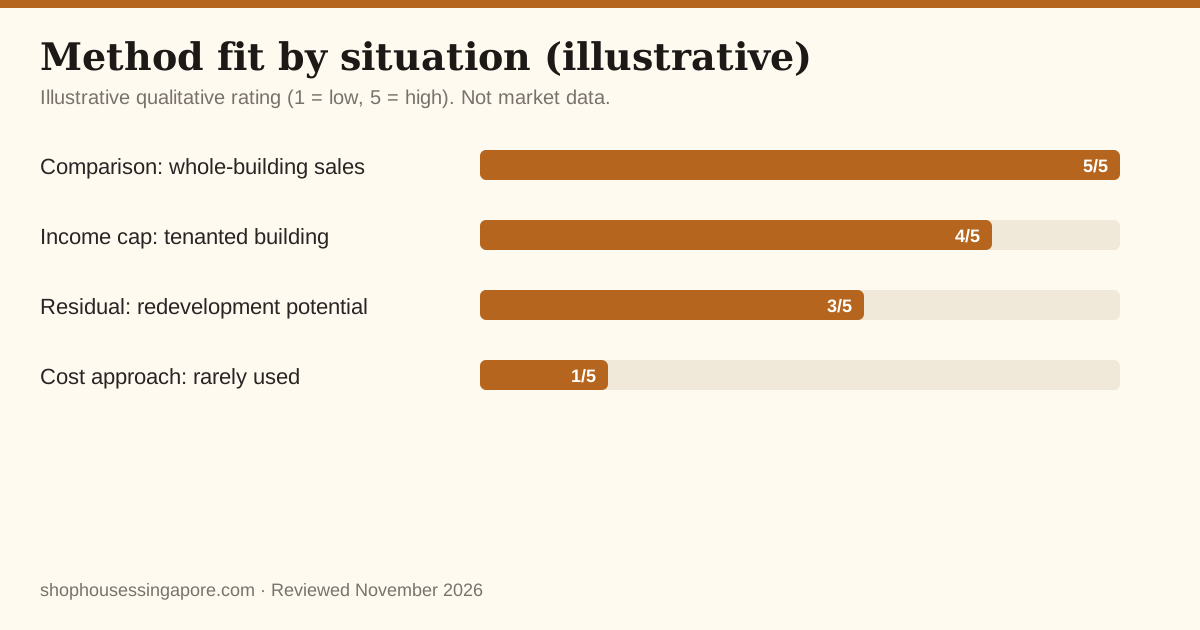
Valuation methods
| Method | How it works | Best for |
|---|---|---|
| Comparison | Adjust recent comparable sales for differences | Most whole-building sales |
| Income capitalisation | Net operating income ÷ capitalisation rate | Income-producing, tenanted buildings |
| Residual | Value after development less costs and profit | Sites with change-of-use or extension potential |
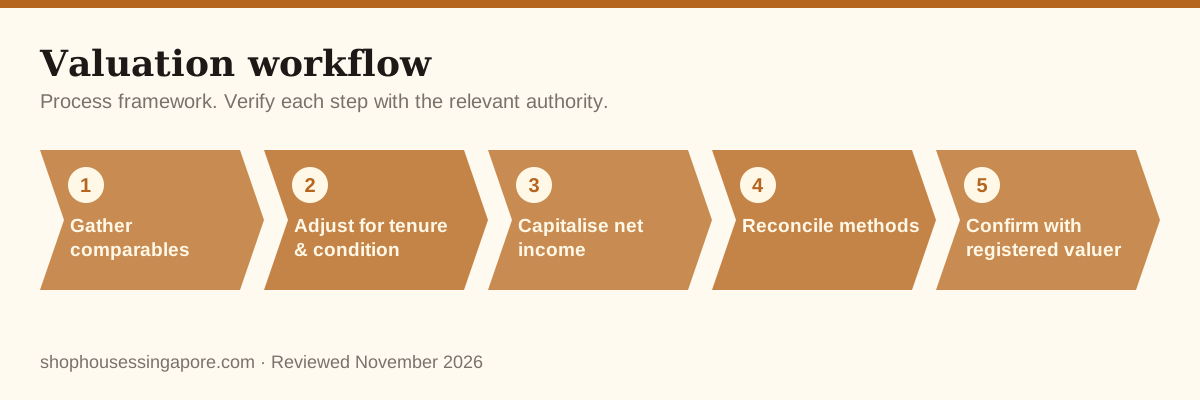
Adjustments specific to shophouses
- Tenure: freehold, 999-year, 99-year remaining lease
- Conservation grade and permitted use under URA
- Condition and restoration backlog
- Number of storeys, frontage and depth
- Lease terms, rent versus market, tenant quality
- Location and footfall
Simple income capitalisation example (illustrative formula)
Value = Net operating income ÷ capitalisation rate. If net income is N and the market cap rate is c, value = N ÷ c. A lower cap rate implies a higher value. Source the cap rate from comparable evidence, not assumption.
Sources and further reading
- URA – Urban Redevelopment Authority — REALIS, property market statistics, conservation guidelines
- SLA – Singapore Land Authority — Land titles, tenure and state-land information
- EdgeProp Singapore — Transaction reports and commercial market commentary
Figures and rules change; confirm current details with the source before transacting. See also all investment and market pages.