

Short answer
Singapore conservation shophouses are valued for capital appreciation because supply is fixed by URA conservation rules, tenures are often freehold or 999-year, and use is flexible. Past growth is not a guarantee, and returns depend on entry price, location, restoration quality and holding period.
- Core thesis
- Fixed supply, land-heavy value
- Tenure premium
- Freehold and 999-year
- Guaranteed?
- No
- Measure with
- Repeat sales + net income
Reviewed November 2026.
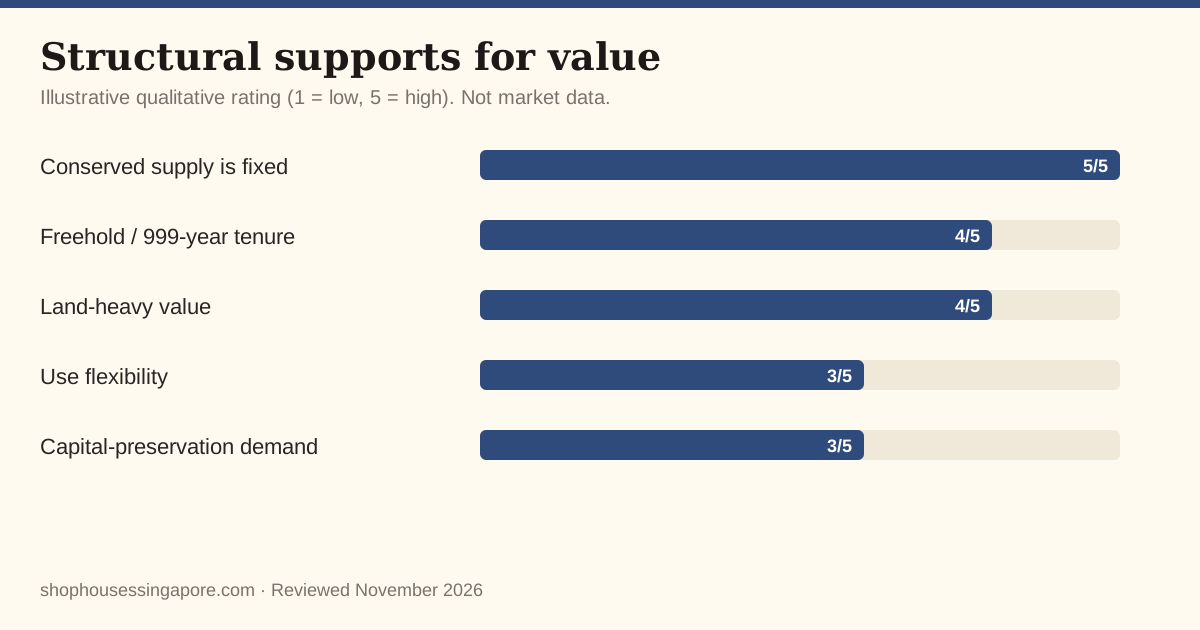
Structural drivers
- Finite supply: conserved buildings cannot be freely replicated.
- Tenure quality: freehold and 999-year stock is scarce.
- Use flexibility: commercial zoning supports F&B, retail and boutique office.
- Land content: value is largely in land rather than a depreciating structure.
- Capital preservation appeal for private investors and family offices.
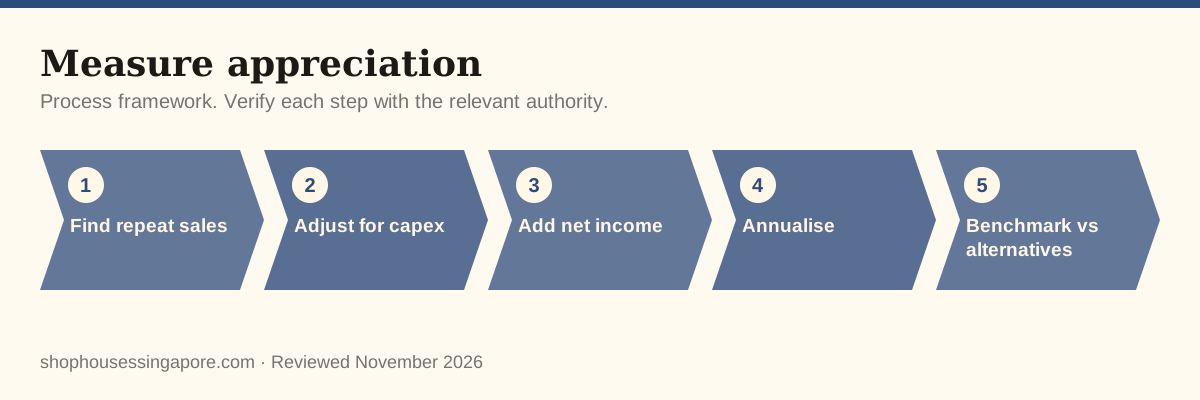
How to measure appreciation
| Step | Detail |
|---|---|
| Find repeat sales | Look up the same address in URA REALIS across time |
| Adjust for capex | Deduct restoration or reconfiguration spend |
| Include income | Total return = capital gain + net rental income |
| Annualise | Compare on a per-year basis against alternatives |
| Benchmark | Against URA commercial indices and other asset classes |
What can cap appreciation
- Buying at peak pricing with thin yield cushion
- Heavy restoration or non-compliance costs
- Weaker tenant demand in a precinct
- Higher financing costs
- Policy or planning changes
Sources and further reading
- URA – Urban Redevelopment Authority — REALIS, property market statistics, conservation guidelines
- EdgeProp Singapore — Transaction reports and commercial market commentary
- SLA – Singapore Land Authority — Land titles, tenure and state-land information
Figures and rules change; confirm current details with the source before transacting. See also all investment and market pages.