

Short answer
Common Singapore shophouse strategies are core income, value-add restoration or repositioning, owner-occupation, F&B-led leasing and long-term legacy holding. Each balances yield, capex, risk and exit differently. Choose based on capital, hands-on capacity, financing and time horizon, and underwrite on net rather than gross income.
- Strategies
- Core, value-add, owner-occupier, F&B-led, legacy
- Underwrite on
- Net yield, not gross
- Stress-test
- Financing costs
- Plan early
- Exit buyer pool
Reviewed November 2026.
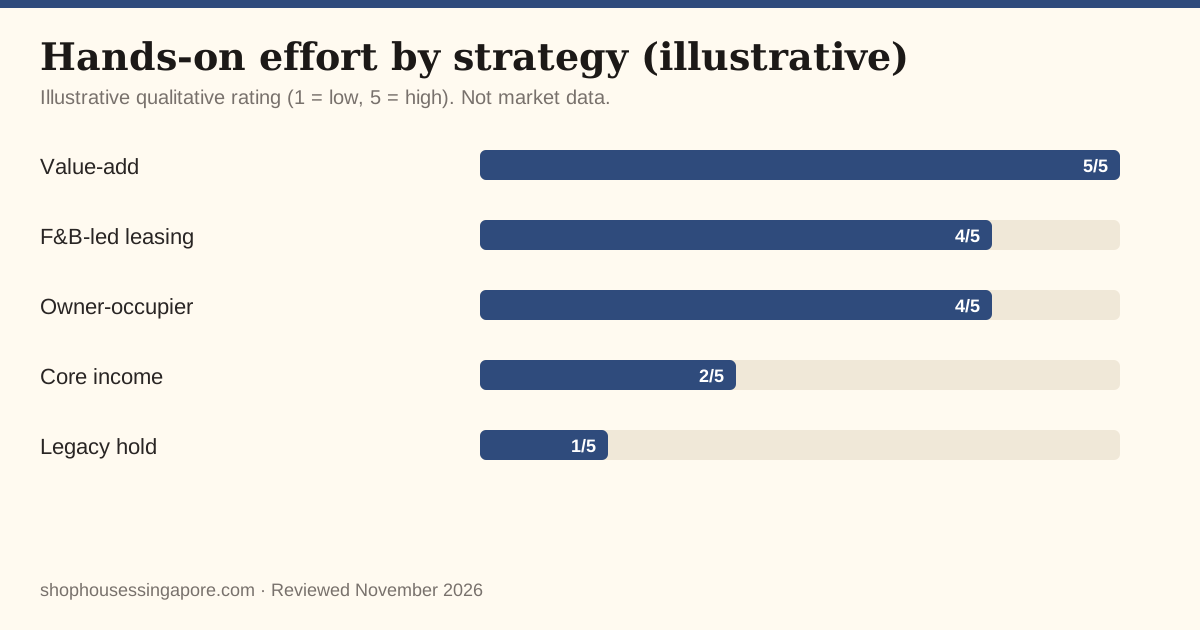
Strategy comparison
| Strategy | Approach | Main risk |
|---|---|---|
| Core income | Buy a stabilised building with good tenants and hold | Pricing risk at entry; lease rollover |
| Value-add | Restore, re-tenant or reconfigure within URA rules | Capex overruns, approvals |
| Owner-occupier | Operate a business in part and lease the rest | Business and property risk combined |
| F&B-led | Target restaurants and bars for higher ground-floor rents | Tenant churn, licensing |
| Legacy / hold | Long hold for scarcity and capital preservation | Illiquidity, opportunity cost |
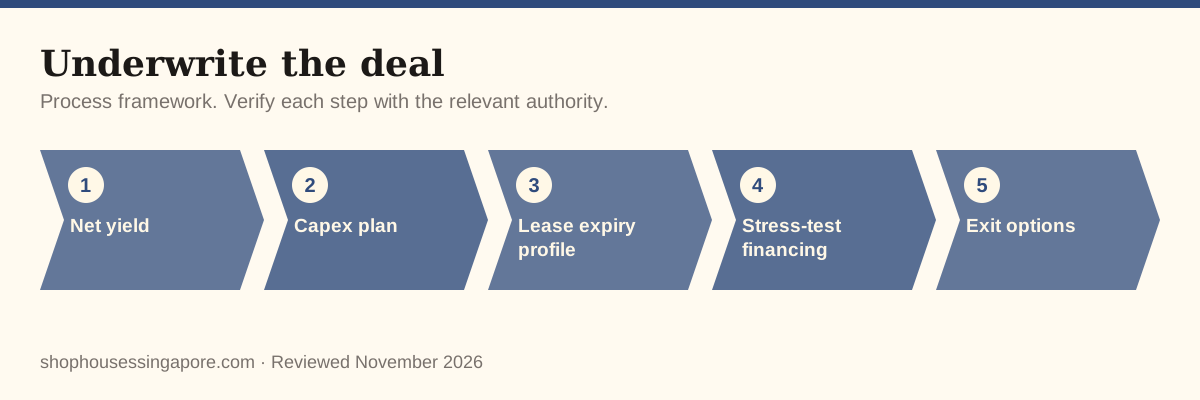
Underwriting checklist
- Net yield after realistic costs
- Capex plan including conservation requirements
- Lease expiry profile and rent-review terms
- Financing terms and stress-tested interest costs
- Exit options and likely buyer pool
Financing note
Lending terms for commercial property differ from residential. MAS framework rules may apply to individual borrowers, so confirm loan-to-value and debt-servicing rules directly with banks and MAS before committing.
Sources and further reading
- URA – Urban Redevelopment Authority — REALIS, property market statistics, conservation guidelines
- MAS – Monetary Authority of Singapore — Property loan rules, REIT regulation, family office schemes
- IRAS – Inland Revenue Authority of Singapore — Stamp duties, property tax, GST on property
Figures and rules change; confirm current details with the source before transacting. See also all investment and market pages.