

Short answer
Singapore shophouse prices follow interest rates, investor demand, tourism and F&B performance, policy such as ABSD on residential use, and the finite supply of conserved buildings. Because deals are infrequent and each building is unique, trends are best read over multiple quarters using URA and broker data.
- Main driver
- Interest rates and financing
- Structural support
- Fixed conserved supply
- Index?
- No standard shophouse-only index
- Read trends over
- Multiple quarters
Reviewed November 2026.
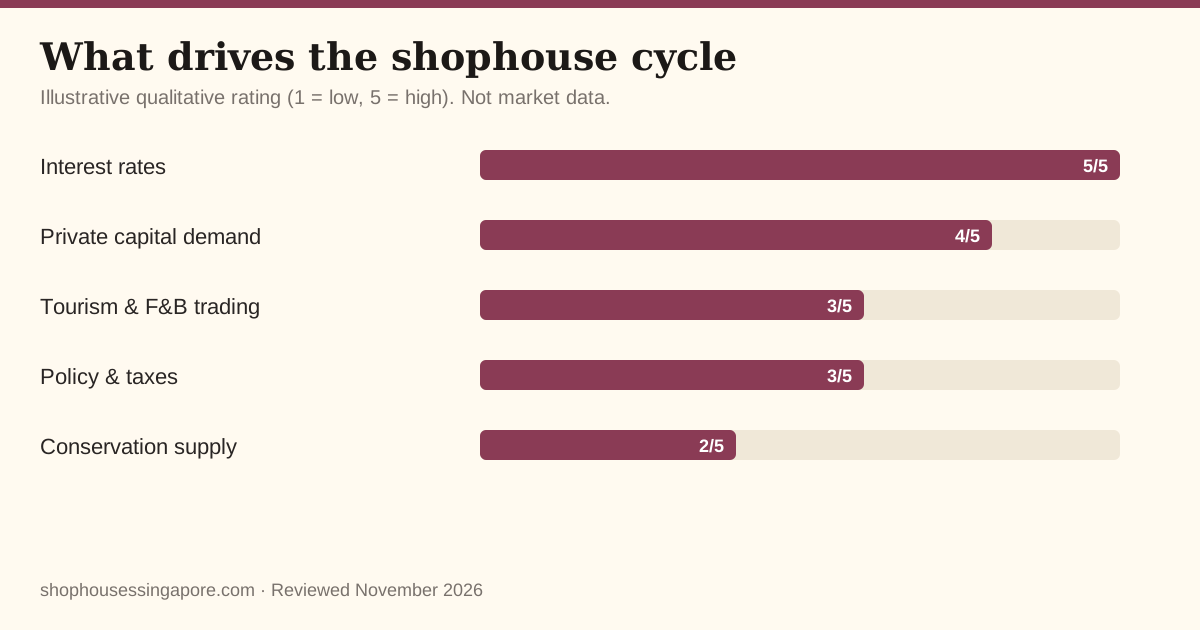
Main drivers of shophouse price cycles
| Driver | Typical effect | How to track |
|---|---|---|
| Interest rates and financing costs | Higher rates pressure pricing and buyer capacity | MAS, bank rate announcements |
| Private capital inflow | Family offices and funds can lift pricing for prime stock | Press and broker investment-sales reports |
| Tourism and F&B performance | Stronger trading supports rents and tenant demand | STB, operator commentary, rental listings |
| Government policy | ABSD and stamp duties affect residential-use deals most | IRAS, MAS, URA announcements |
| Conservation supply | Fixed supply supports long-run scarcity value | URA conservation areas |
Why shophouse indices are hard to build
Shophouses are unique, trade rarely, and are often sold off-market. URA publishes price and rental indices for broad commercial categories, but a pure shophouse index is not a standard official series, so brokers and researchers use caveat data and judgement. Treat any single quarter as noise and look for multi-quarter patterns.
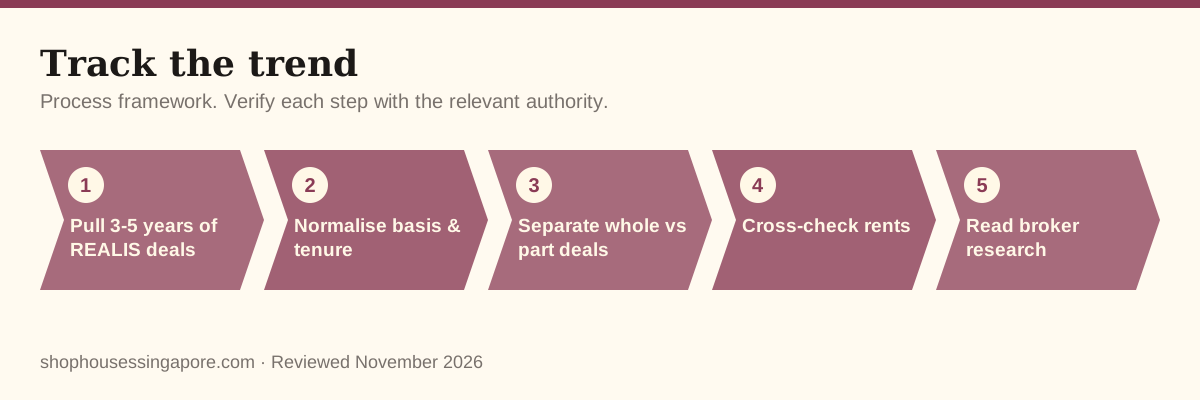
A practical way to read the trend
- Pull transactions for your precinct for at least the last 3–5 years from REALIS.
- Normalise to the same basis (land or built-up psf) and tenure.
- Separate whole-building deals from part-building or strata deals.
- Cross-check with rental evidence, not only sale prices.
- Read broker research for context on buyer demand.
Sources and further reading
- URA – Urban Redevelopment Authority — REALIS, property market statistics, conservation guidelines
- MAS – Monetary Authority of Singapore — Property loan rules, REIT regulation, family office schemes
- EdgeProp Singapore — Transaction reports and commercial market commentary
- Knight Frank Singapore Research — Brokerage research on investment sales
Figures and rules change; confirm current details with the source before transacting. See also all investment and market pages.