

Short answer
A shophouse offers direct land ownership, control and scarcity, but is illiquid and management-intensive. Condos are more liquid and carry ABSD for second homes; strata offices add supply risk; S-REITs offer liquid diversified exposure without control. The best choice depends on capital, hands-on appetite and horizon.
- Shophouse
- Control, scarcity, low liquidity
- Condo
- More liquid; ABSD rules
- Strata office
- Smaller commercial ticket
- S-REIT
- Liquid, diversified, passive
Reviewed November 2026.
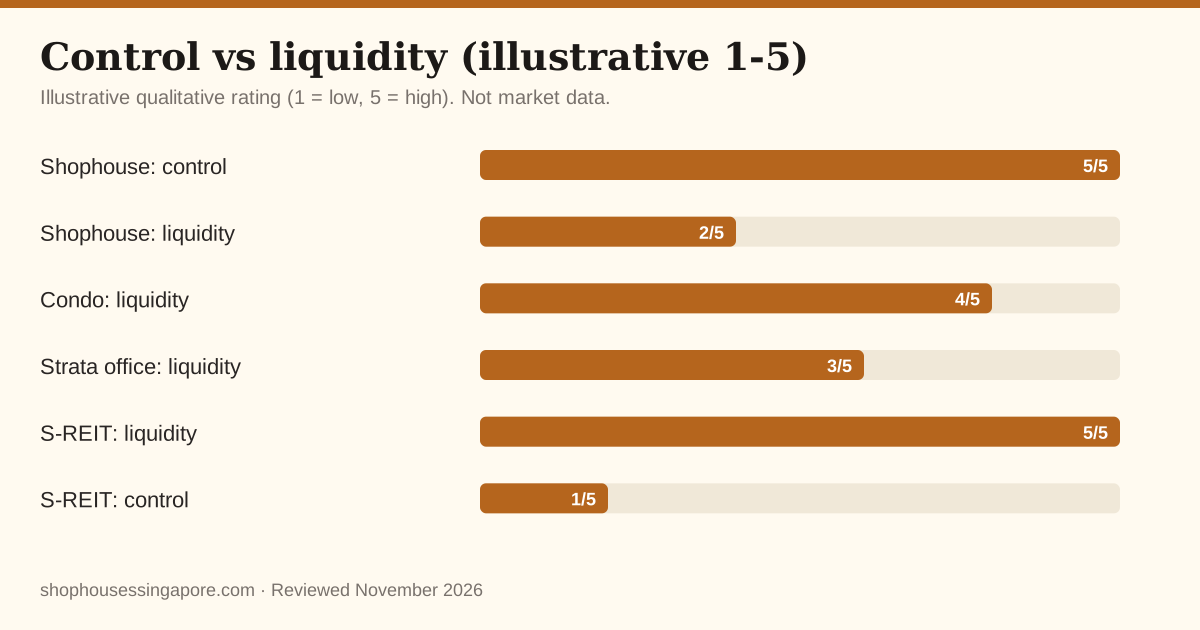
Comparison table
| Factor | Shophouse | Condo | Strata office | S-REIT |
|---|---|---|---|---|
| Ownership | Direct, land-based | Strata unit | Strata unit | Units in a trust |
| Control | High | Medium | Medium | None |
| Liquidity | Low | Medium–high | Medium | High (listed) |
| Entry size | Large | Medium | Medium | Small |
| Management | Active | Limited | Moderate | Professional manager |
| Scarcity | High | Lower | Lower | n/a |
| ABSD | Residential use only | Applies per ABSD rules | Not applicable (commercial) | Not applicable |
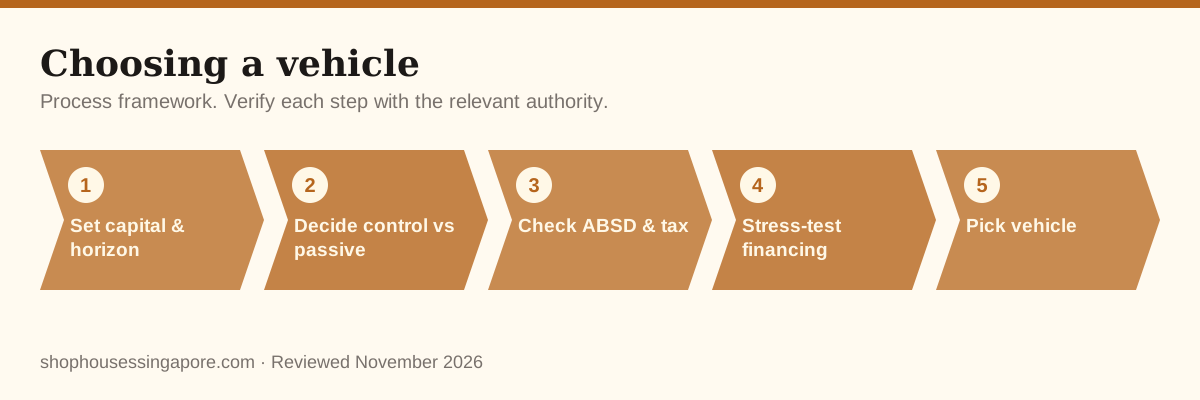
Key differences
- REIT distribution: S-REITs generally distribute most taxable income to unitholders, and are subject to MAS leverage limits.
- Shophouses can carry conservation obligations that strata assets do not.
- Shophouse value is concentrated in land; strata assets depreciate with the building and lease.
- A single shophouse is concentrated risk; REITs diversify across many properties.
When each fits
- Shophouse: investors wanting control and scarce land exposure with long horizon.
- Condo: residential demand and easier exit.
- Strata office: smaller-ticket commercial income.
- REIT: liquid, passive, diversified property exposure.
Sources and further reading
- IRAS – Inland Revenue Authority of Singapore — Stamp duties, property tax, GST on property
- MAS – Monetary Authority of Singapore — Property loan rules, REIT regulation, family office schemes
- URA – Urban Redevelopment Authority — REALIS, property market statistics, conservation guidelines
Figures and rules change; confirm current details with the source before transacting. See also all investment and market pages.