

Short answer
The outlook for Singapore shophouses depends on interest rates, private-capital demand, tourism and F&B health, and policy. Fixed conservation supply is a structural support, but prices remain cyclical. Rather than forecasts, track indicators from URA, MAS and brokers and test returns under several scenarios.
- Approach
- Scenarios, not forecasts
- Watch
- Rates, URA statistics, demand
- Support
- Finite conserved stock
- Reviewed
- November 2026
Reviewed November 2026.
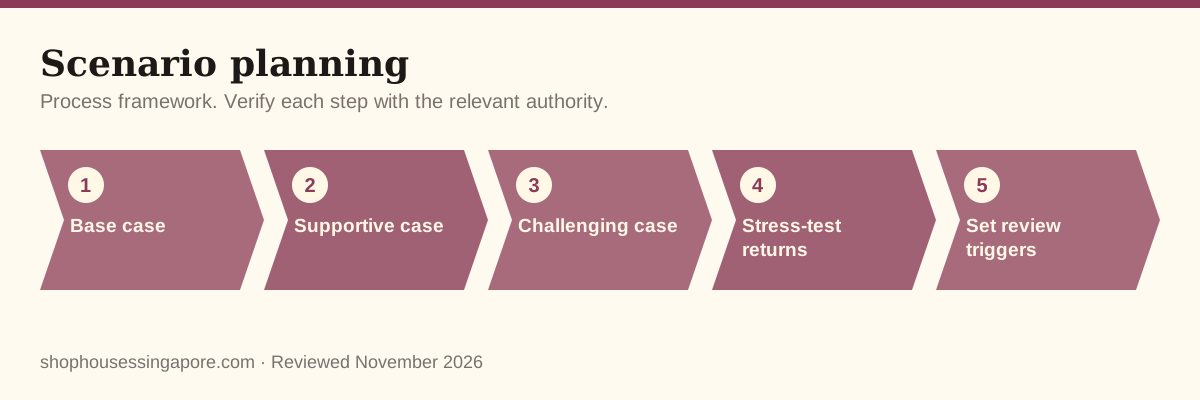
Scenario framework
| Scenario | Conditions | Likely effect |
|---|---|---|
| Supportive | Easing rates, strong tourism and F&B | Firmer demand and pricing |
| Neutral | Stable rates and steady leasing | Sideways pricing, income-driven returns |
| Challenging | Higher rates or weak trading | Softer pricing, longer sales cycles |
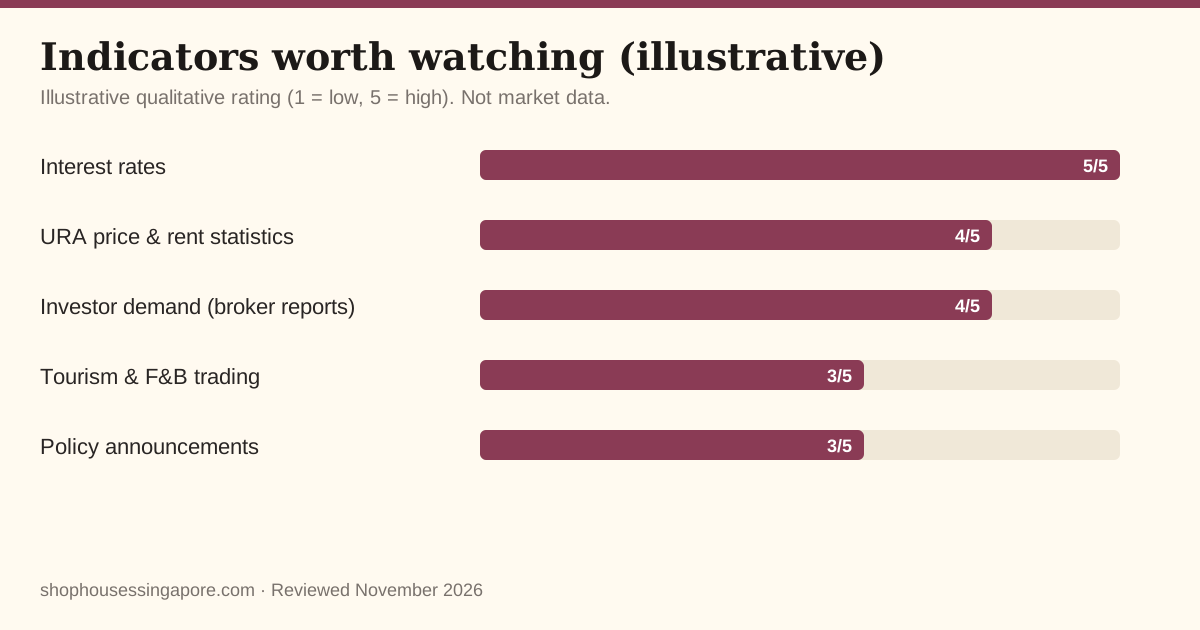
Indicators to monitor
- URA quarterly commercial price and rental statistics
- MAS monetary policy statements and bank rates
- Tourism arrivals and F&B trading commentary
- Brokerage investment-sales reports
- Policy announcements on property taxes and duties
Structural supports
- Finite conserved stock under URA guidelines
- Singapore's role as a wealth and family-office hub
- Appetite for freehold and long-tenure assets
Sources and further reading
- URA – Urban Redevelopment Authority — REALIS, property market statistics, conservation guidelines
- MAS – Monetary Authority of Singapore — Property loan rules, REIT regulation, family office schemes
- Knight Frank Singapore Research — Brokerage research on investment sales
- EdgeProp Singapore — Transaction reports and commercial market commentary
Figures and rules change; confirm current details with the source before transacting. See also all investment and market pages.