
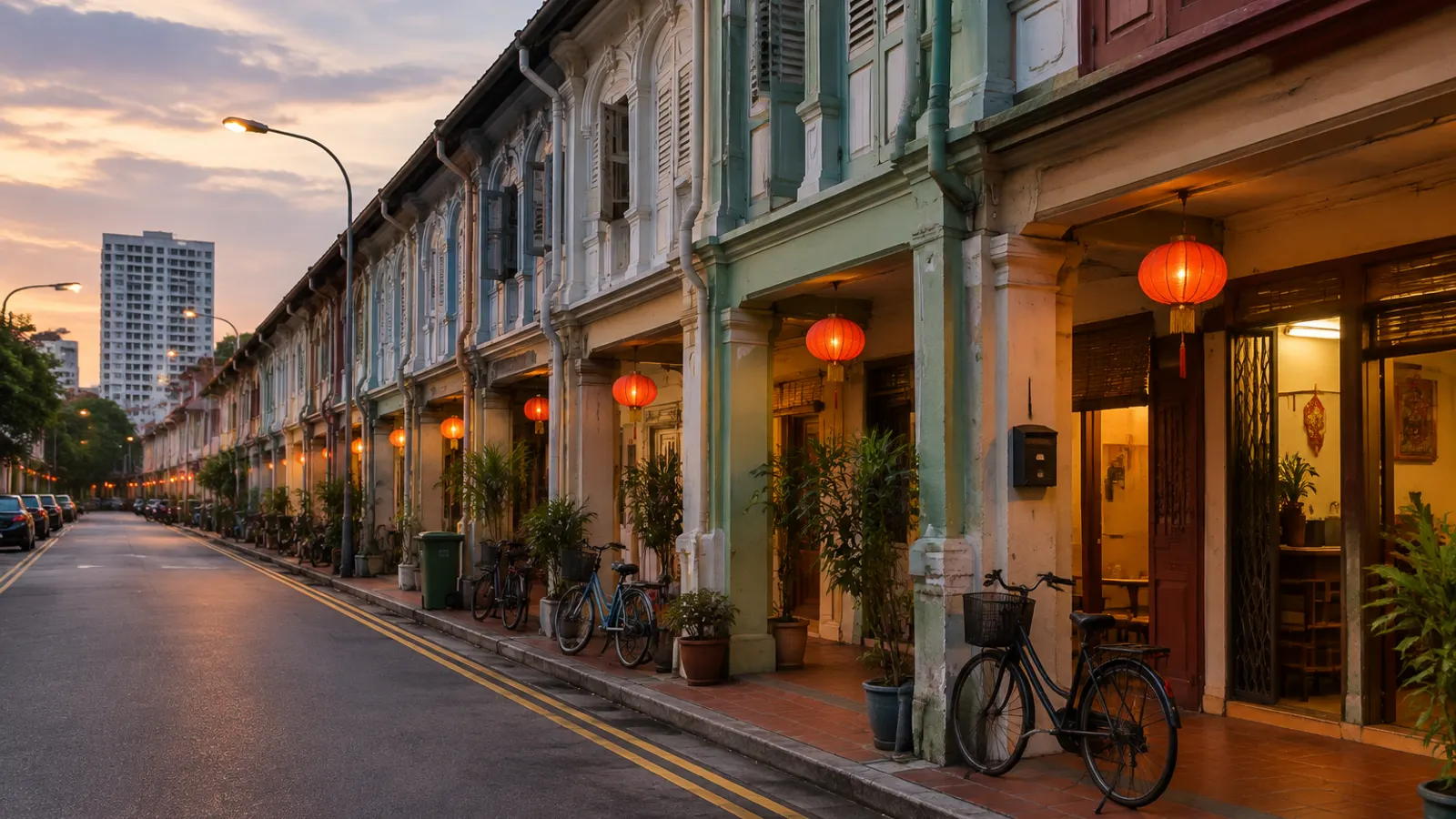
D14 · Neighbourhood guide
Geylang shophouses
A frank, neutral guide to Geylang shophouses: the Malay heartland, the Lorong grid, the food scene, what to check on any Geylang shophouse for sale or Geylang shophouse for rent, and the redevelopment pressures around Paya Lebar.
Geylang shophouses line Geylang Road and a grid of numbered lorongs east of the city, mixing the Malay heartland of Geylang Serai, a celebrated food scene, older conserved pockets and a regulated zone in specific lorongs. For anyone searching a Geylang shophouse for sale or for rent, the exact lorong is the biggest value and diligence variable.
Editorial review as of 5 November 2026. Related: Geylang · D14–15 East · all neighbourhoods.
| Postal district | Mainly D14 (Geylang / Eunos / Paya Lebar), with edges touching neighbouring districts |
|---|---|
| Nearby MRT | Paya Lebar (EW8 / CC9), Aljunied (EW9), Eunos (EW7), Kallang (EW10), Dakota (CC8), MacPherson (CC10 / DT26) and Geylang Bahru (DT24) |
| URA conservation status | Pockets of conserved shophouses exist; status varies street by street, so check the URA conservation map for each lot |
| Core character | Geylang Serai Malay-Muslim heartland, Geylang Road main spine, numbered lorongs, food and wholesale trades |
| Typical uses | F&B, retail, services, workshops, trading, offices, serviced and residential-use lodging where approved |
| Tenure mix | Freehold, 99-year and 999-year titles all occur; verify each lot |
| Special diligence factor | A regulated zone in specific lorongs affects use, tenant profile and valuation sentiment nearby |
| Redevelopment context | Paya Lebar Quarter and the Paya Lebar regional centre sit at the northern edge of the district |
A short history of Geylang and Geylang Serai
In Geylang the street name matters more than the district name: two lorongs apart can mean two different assets.
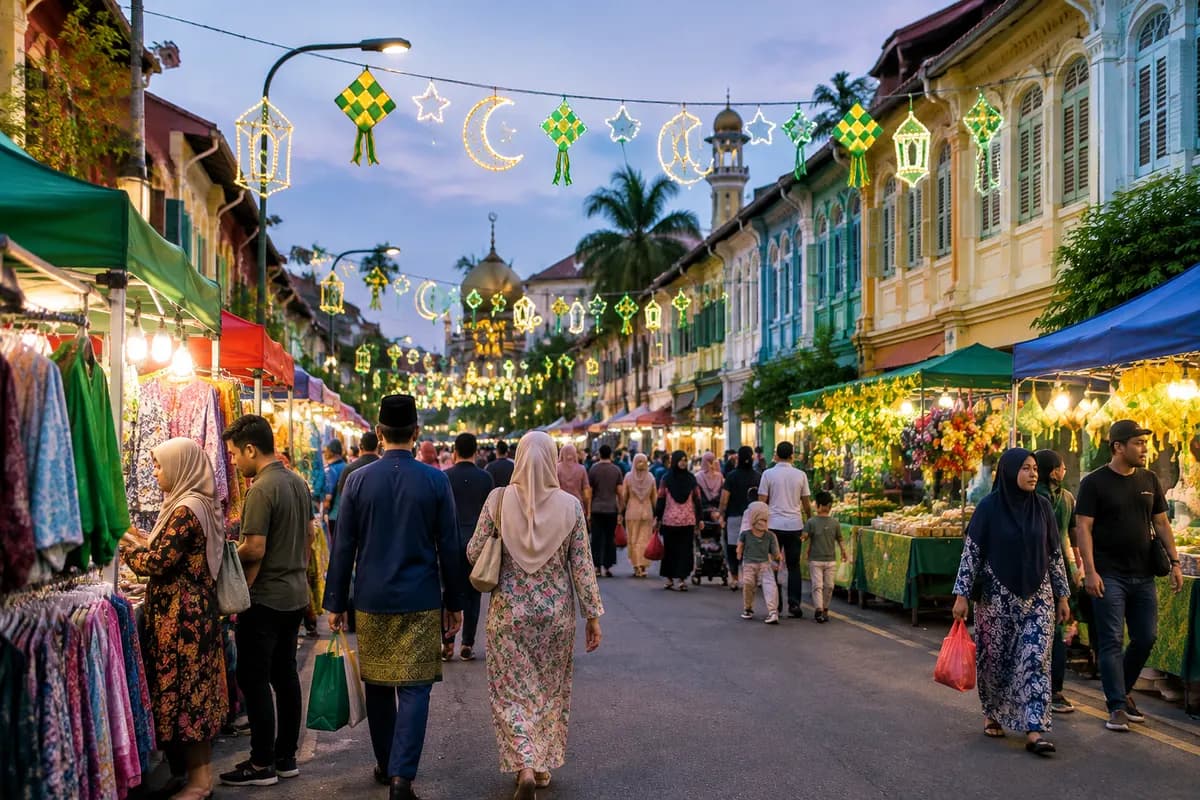
Geylang began as a semi-rural area east of the Singapore town, with coconut and lemongrass plantations, kampongs and small industries. The name of Geylang Serai is commonly linked to serai, the Malay word for lemongrass, which was cultivated in the area, though place-name origins are always worth treating with caution and checking against heritage sources such as Roots.gov.sg.
Over the twentieth century, Geylang Serai became the heartland of Singapore's Malay community. Kampongs and later public housing, markets, mosques and cultural institutions shaped the district, and its Hari Raya bazaar became a well-known annual event. This heritage gives the area a very different identity from the Chinese-merchant shophouse districts of the CBD.
Alongside Geylang Serai, the broader Geylang area developed as a dense urban neighbourhood of shophouses, coffeehouses, temples, clan associations and light industry. Its location along the main road east from the city made it a natural place for trade, food and accommodation, and that layered history is still visible in the street pattern.
For related heritage districts further east, compare our Joo Chiat and Katong area pages, and see the Geylang area page for the wider overview.
Geylang Serai: the Malay heartland
Geylang Serai is the cultural centre of Malay-Muslim life in Singapore's east. Its market and food centre are community landmarks, and the surrounding streets host traders selling traditional food, textiles, garments and household goods. During Ramadan and the lead-up to Hari Raya Aidilfitri, the area's bazaar and lights draw visitors from across the island.
For a property reader, the importance of Geylang Serai is that its demand base is local and community-driven. Many businesses serve everyday shoppers and families, and the trading pattern follows the religious and cultural calendar. A shophouse unit here is valued by its fit with that customer base, not by tourist traffic.
Respect for the community is also a practical diligence point. Operators who understand halal requirements, prayer times and seasonal peaks will fit in more successfully, and landlords should consider how their tenant selection and signage sit within the area's character.
Geylang Road, the lorong grid and the Geylang shophouse stock
Geylang Road is the main spine, and the district is organised around a grid of numbered lorongs, which are lanes running off it. There are dozens of lorongs, and their character differs a great deal from one to the next. Some are quiet and residential in feel, some are heavily food-oriented, and some are associated with the regulated zone discussed below.
The shophouse stock is varied. You will find pre-war terraces with ornate details, post-war shophouses of simpler design, and later blocks that follow the shophouse typology without the heritage features. Ground floors are usually shops, eateries or workshops, while upper floors may serve as offices, storage or lodging, depending on the approved use.
Because condition and compliance vary, careful inspection matters more here than in more uniformly restored districts. Check structure, wet areas, fire safety, extensions to the rear and any unauthorised partitioning, particularly where upper floors have been subdivided for multiple occupants.
- The lorong number is not a quality score; check each street's character in person, by day and at night.
- Older units may have rear extensions or subdivisions that were never approved.
- Conservation status is not uniform across the district.
Conservation shophouses in Geylang
Parts of Geylang's shophouse stock fall under conservation, and the first conservation areas were gazetted in 1989 elsewhere in the city. Conservation in Geylang is more patchy than in the CBD or Kampong Glam, so you cannot assume that any given shophouse is conserved or unconserved. Check the URA conservation map and written guidelines for the exact address.
If a unit is conserved, façade, roof form and other protected features must be retained, and works require approvals. If it is not conserved, redevelopment rules are different, which has big implications for value and potential. This distinction is among the most important facts to establish at the start of due diligence.
Our URA conservation guidelines buyer manual explains the categories and approvals in detail. Pair it with our conservation shophouses for sale hub when comparing inventory.
Food scene: why Geylang draws diners from across the island
Geylang's food reputation is well established. The area is known for late-night eating, with famous stalls and restaurants serving claypot rice, frog-leg porridge, seafood, Malay and Indonesian dishes, Chinese regional cuisines, and durian during the season. Many visitors come from outside the district specifically to eat here.
From an operator's standpoint, that creates a strong specialist-dining catchment and an expectation of value. Customers come for the food rather than the décor, which suits shophouse units that offer basic, functional dining rooms. It also means rents and fit-out budgets generally need to be disciplined.
Licensing and compliance still apply. A unit that has long been a food outlet is not guaranteed to be approved for every kind of cooking. Read our F&B licensing and change-of-use guide and check ventilation, grease management and operating hours with the authorities before committing.
Uses and tenant mix beyond food
Food is the visible face of Geylang, but the tenant base is broader. Provision shops, textile and garment traders, money-changers, barbers, clinics, electrical and hardware suppliers, workshops and small wholesalers all occupy shophouse ground floors, serving both the local community and passing trade along Geylang Road.
Upper floors are used flexibly. Some are offices or storage for the shop below, while others have historically been used for lodging. Whether a given upper floor may lawfully be used as living quarters, a hostel or short-stay accommodation depends on planning approvals and other regulations, so never rely on the way the space is currently used.
This diversity is a strength for income stability, because a unit can be re-let to several kinds of trade. It also means that a tenant covenant check and a clear permitted-use clause in the lease matter more than the label on the signboard.
The regulated zone: a neutral view of a diligence factor
Geylang is also known for a regulated area in certain lorongs, where activity that is otherwise restricted in Singapore is policed and managed under a specific framework. This is a fact that affects property decisions, and we address it plainly rather than ignoring it. The details of the legal framework are best confirmed from official sources and your lawyer, and you should not rely on informal descriptions.
For buyers and tenants, the relevance is practical. Proximity to the regulated lorongs can influence the type of tenant willing to take a space, the family and corporate demand for nearby units, the feel of the street at night, and how financiers and valuers view a property. Effects vary from lorong to lorong and even building to building.
Landlords also carry legal responsibilities regarding how premises are used. Ask your lawyer to explain obligations under applicable legislation and the tenancy, including what protections you need if a tenant misuses the premises. Make sure the lease prohibits unlawful uses and gives you remedies.
A sensible approach is to visit the exact street at several times of day, speak to neighbouring businesses, request valuations and financing views early, and avoid assuming that either a discount or a premium applies automatically. Treat it as one of several factors, alongside condition, tenure and conservation status.
MRT, transport and walkability
Geylang is served by several MRT lines, but no single station covers the whole district. Paya Lebar (EW8 / CC9) on the East-West and Circle lines is a major interchange at the northern edge. Aljunied (EW9), Eunos (EW7) and Kallang (EW10) sit on the East-West Line, while Dakota (CC8) and MacPherson (CC10 / DT26) are on the Circle Line, and Geylang Bahru (DT24) is on the Downtown Line.
That means walking distance varies enormously. A unit close to Paya Lebar or Aljunied will have a very different commuter profile from one deep in the lorongs, so measure the actual walking route rather than relying on a map radius. Check bus services along Geylang Road and Sims Avenue as well.
Road access is good by car and delivery vehicle, which suits trading, wholesale and food-supply businesses. Parking and loading are tight in older streets, so inspect loading arrangements and any restrictions on the specific lorong.
Redevelopment, Paya Lebar Quarter and the longer-term outlook
Paya Lebar Quarter, an integrated commercial, retail and residential development next to Paya Lebar MRT, and the wider Paya Lebar regional centre have raised the profile of the district's northern edge. Newer offices, malls and residential towers have brought a different, more corporate and residential customer base close to the older shophouse streets.
Longer-term planning announcements, including the intended relocation of Paya Lebar Air Base and the associated easing of building-height controls, have been a recurring part of discussions about the area's future. We do not make predictions here, but potential buyers should read current URA masterplan information and not assume what will or will not change.
For non-conserved shophouses, redevelopment potential is a real consideration, subject to planning rules. For conserved ones, retention is required. Which side of that line your unit falls on drives how you should value it, so confirm status first.
Shops in Geylang shophouses and the Lorong 24A series of streets
Shops in Geylang shophouses range from provision stores and eateries to workshops, clinics and trading offices. Searches for a particular address, such as a Lorong 24A Geylang shophouse, or for any lorong in the 20s, usually come from people trying to learn what a specific lane is like. Lettered lorongs such as 24A sit between numbered ones and are easy to overlook when comparing listings.
Many lorongs in the middle of the numbering sequence fall within or beside the regulated zone discussed later on this page, while others are mainly residential or food-led. Do not infer the character of a street from its number alone. Check the street in person, ask nearby operators, and review the planning and conservation status of the individual lot.
When you compare listings, record lorong, tenure, storey count, approved use, frontage and condition in a simple table. Differences between units on the same lane are often as large as differences between lanes, so a Lorong 24A shophouse is best valued against nearby sales and lettings, not against district-wide claims.
Geylang shophouse fire safety and SCDF compliance
Fire safety is a standing concern for older, densely built shophouse terraces anywhere in Singapore, and Geylang is no exception. Searches such as Geylang shophouse fire reflect public interest in incidents, but for owners and tenants the practical question is compliance: does the building meet current Singapore Civil Defence Force (SCDF) fire safety requirements for its approved use?
Points to check include approved use versus actual use, fire alarm and extinguisher provisions, means of escape from upper floors, unauthorised partitions or subdivisions that block escape routes, kitchen exhaust and grease management for food outlets, electrical loads, and storage of goods in stairwells. Where upper floors have been subdivided for lodging, scrutiny is higher.
Owners are generally responsible for keeping the building compliant, and tenants for their fit-out and operations, but allocation depends on the lease. Ask for the fire safety certificate position where applicable, engage a qualified person for any changes, confirm insurance cover for fire and public liability, and have your lawyer review the lease clauses on compliance and indemnity.
- Match approved use to actual use on every floor.
- Keep escape routes and stairwells clear of storage and partitions.
- Check kitchen exhaust, grease management and electrical capacity for F&B.
- Confirm insurance and who bears compliance cost under the lease.
Geylang shophouse tenants locked out and new-owner lockouts: what to know
Disputes in which tenants say they have been locked out, or in which a new owner takes control of a shophouse, draw a lot of public attention. We do not comment on any specific case here. What follows is general, factual orientation on how landlord and tenant relationships are normally structured, and it is not legal advice.
A landlord cannot normally rely on self-help alone. Remedies for unpaid rent or breach, such as distress for rent, forfeiture and re-entry or termination under the lease, are governed by the tenancy agreement and by law, and they often require specific notices, steps or court processes. A lock change that skips the proper steps can expose a landlord to claims, so tenants who find themselves excluded should get legal advice promptly and keep records.
When a shophouse is sold, the buyer generally acquires it subject to existing tenancies that are legally binding on it, but the details depend on the lease terms, its duration and whether it is registered or otherwise protected. A new owner does not automatically gain the right to end a lease. Buyers should review every tenancy during conveyancing and confirm in writing what the vendor has disclosed.
For tenants, the main protections are a clear written lease, a valid and stamped tenancy agreement, evidence of rent paid, a defined notice and cure period for breach, and a clause on what happens if the property is sold. Ask your lawyer about assignment of the lease to a new owner, security deposit handling and what happens to your goods and fit-out.
For buyers, the checks are the rent roll, arrears, any notices already served, disputes in progress, sub-tenancies and occupiers not named in the lease, and vacant possession terms in the sale contract. If you intend to take over premises, follow the lawful process and do not rely on informal arrangements. Independent legal advice before exchange is the most useful safeguard.
- Tenants: keep the signed lease, receipts and notices; seek legal advice early.
- Tenants: negotiate notice and cure periods and a sale-of-property clause.
- Buyers: review every tenancy, arrears and pending disputes during conveyancing.
- Buyers: agree in the contract whether the unit is sold with vacant possession or with tenants.
- Both: avoid self-help; use the lease terms and lawful legal process.
Price and rent context: positioning without figures
Editorial review as of 5 November 2026; no figures quoted here—verify current transactions. Geylang is generally seen as a value-oriented, trade-and-food shophouse district compared with the CBD fringe, with pricing driven by street, tenure, conservation status, condition and use rather than by one district-wide figure. Premium and discount factors can coexist within a few hundred metres.
Since the district is so varied, comparing like with like is essential. A freehold, conserved, well-located unit near Paya Lebar is not comparable with a leasehold unit deep in a lorong. Build a comparison set by street, tenure and use, and be sceptical of broad averages.
| What to benchmark | Where to find it | Why it matters |
|---|---|---|
| Recent transactions on the same lorong or adjoining streets | URA REALIS or URA SPACE; SRX and EdgeProp transaction data | Street-level evidence matters more than district averages in a varied area |
| Tenure and remaining term | SLA title search via your lawyer | Freehold, 99-year and 999-year titles value differently |
| Conservation status and permitted use | URA conservation map and planning enquiry | Determines redevelopment potential and alteration limits |
| Rental benchmarks for shop, food and office space | URA rental statistics; SRX and EdgeProp rental listings | Shows market rent for the specific use |
| Existing tenancy and tenant profile | Tenancy agreement and rent roll | Income security and the character of the occupants |
| Lender and valuer appetite for the street | Bank valuation quotes and mortgage broker feedback | Financing terms can differ near sensitive lorongs |
| Property tax and stamp duty | IRAS property tax and stamp duty pages | Running costs and upfront cost shape net returns |
Geylang shophouse for sale or for rent: investment angle and checklist
The investment case for Geylang is about specific, well-chosen units rather than the district as a label. Positive factors include food-led demand, access to several MRT lines, proximity to Paya Lebar's commercial growth and a deep local customer base. Negative factors include reputational sensitivity in some lorongs, uneven building condition and varied conservation status.
Before buying, establish tenure, conservation status, approved use, and the full history of alterations. Then walk the street at night, review the tenant base, and get financing feedback early. Read investing in Singapore conservation shophouses, the freehold shophouses guide and the commercial vs residential ABSD breakdown.
For live inventory, browse commercial shophouses for sale, and if you are an operator, the shophouses for rent hub. Compare several lorongs before deciding.
- Confirm tenure, conservation category and approved use first.
- Visit at multiple times of day, including late evening.
- Obtain approved plans and look for unauthorised subdivision.
- Ask a lender for a valuation view before committing.
- Draft lease terms that clearly prohibit unlawful use.
- Plan exit routes, including owner-operator and developer buyers.
Risks and nearby areas
Key risks include reputational and tenant-mix effects near the regulated lorongs, uneven building quality, compliance gaps in older units, and uncertainty over long-term planning changes. Liquidity can also be thinner for units in less-sought-after streets, so allow for a longer sale period.
To compare, look at Jalan Besar and Little India for other multicultural, trade-oriented shophouse districts, or Kampong Glam for another Malay heritage centre with a more tourist-facing profile. Closer to home, Joo Chiat and Katong offer more lifestyle-led conservation stock.
Sources
Frequently Asked Questions
Are Geylang shophouses conserved?+
Some are, but not all. Conservation status varies by street and building, so check the URA conservation map and guidelines for the exact address before assuming anything about alteration or redevelopment rights.
What is Geylang Serai known for?+
Geylang Serai is the heartland of Singapore's Malay-Muslim community, known for its market and food centre, traditional trades and the Hari Raya bazaar and lights during Ramadan.
Which MRT stations serve Geylang?+
Several, including Paya Lebar (EW8 / CC9), Aljunied (EW9), Eunos (EW7), Kallang (EW10), Dakota (CC8), MacPherson (CC10 / DT26) and Geylang Bahru (DT24). Which is closest depends on the lorong.
How does the regulated zone affect shophouse investment?+
It is a diligence factor, not a fixed rule. Proximity can influence tenant demand, street atmosphere, valuations and financing views. Visit the exact street at different times, get lender feedback early and have your lawyer advise on landlord obligations.
Is Geylang good for F&B tenants?+
It has a strong, destination food reputation and a deep local customer base, which suits value-focused operators. Confirm that the unit's approved use, ventilation and licences support your concept.
Does Paya Lebar Quarter affect Geylang shophouses?+
It has brought a larger office, retail and residential population close to the district's northern edge, which can support demand for nearby F&B and services. Effects vary by street, so verify with current planning information and transaction data.
What should tenants do if they are locked out of a Geylang shophouse?+
Seek legal advice promptly and keep the lease, rent receipts and any notices. A landlord's remedies for arrears or breach are governed by the lease and by law and normally require proper steps, so how a lockout is handled matters. This is general information, not legal advice.
Does a new owner of a Geylang shophouse have to honour existing leases?+
Generally a buyer takes the property subject to tenancies that are legally binding on it, and a sale does not automatically end a lease. Terms, duration and registration matter, so buyers should review every tenancy in conveyancing and agree the vacant possession position in the contract.
What fire safety checks apply to a Geylang shophouse?+
Confirm that actual use matches approved use, that escape routes are clear, that alarms, extinguishers and kitchen exhaust meet SCDF requirements, and that insurance is in place. Unapproved subdivision of upper floors is a common red flag.
Where can I find a Geylang shophouse for sale or for rent?+
Start with the commercial shophouses for sale and shophouses for rent hubs on this site, then cross-check lorong, tenure and approved use against URA and SLA records. Compare several lorongs, including lettered ones such as Lorong 24A, before shortlisting.
How do I check current Geylang prices and rents?+
Use URA REALIS or URA SPACE for transactions, SRX or EdgeProp for listings, and URA rental statistics for shop and office space. This page quotes no figures, so verify current data for the exact lorong and tenure.