
D08 · Neighbourhood guide
Little India shophouses
A practical guide to Little India shophouses, one of Singapore's busiest conserved districts: the streets, the trade, the heritage controls and the due diligence that matters before you buy or lease.
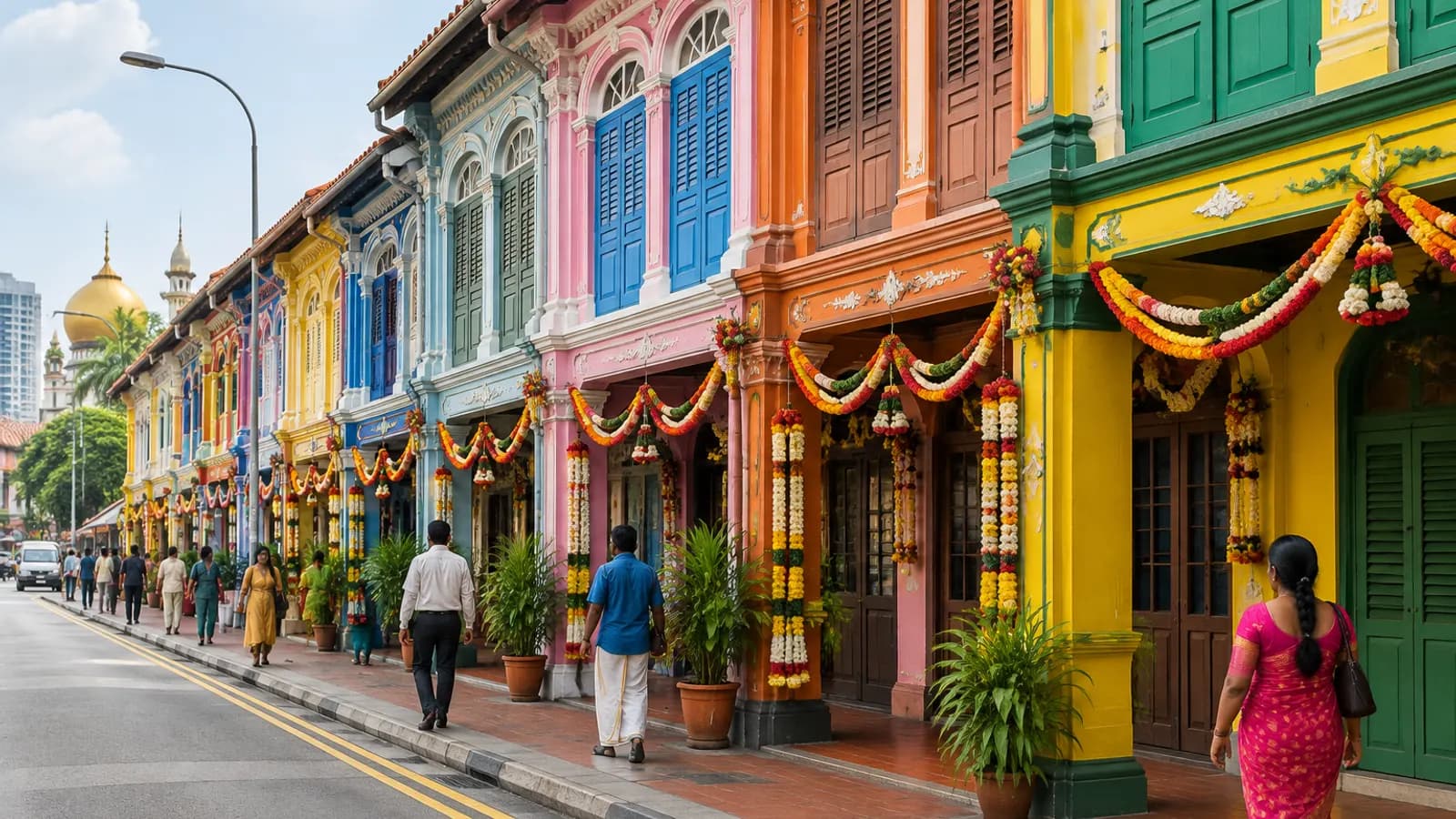
Little India shophouses are conserved heritage buildings in postal district 08 centred on Serangoon Road, with Campbell Lane, Dunlop Street, Buffalo Road and Race Course Road forming the core. Its shophouses carry heavy pedestrian traffic and suit retail, food, services and small hospitality, all under URA conservation controls that restrict façade and structural change.
Editorial review as of 5 November 2026. Related: Little India · D07–08 City Fringe · all neighbourhoods.
| Postal district | D08 (Little India / Farrer Park / Jalan Besar fringe) |
|---|---|
| Nearest MRT | Little India (NE7 North East Line, DT12 Downtown Line); Farrer Park (NE8 North East Line); Rochor (DT13) and Bendemeer (DT23) on the Downtown Line nearby |
| Heritage anchors | Sri Veeramakaliamman Temple, Abdul Gaffoor Mosque, Indian Heritage Centre, Tekka Centre, Little India Arcade |
| URA status | Conservation area; one of the historic districts brought under conservation following the first conservation areas gazetted in 1989 |
| Typical building form | Two- to three-storey terraces, five-foot ways, many with colourful façades, plus pockets of Art Deco and Early Modern buildings |
| Typical uses | Food and grocery retail, textiles, jewellery, flower and prayer-item trade, services, small hospitality, selected offices |
| Tenure | Mixed; verify freehold or leasehold title for each lot via an SLA title search |
| Who buys or rents | Owner-operators, local trading families, hospitality investors, long-hold investors |
Why Little India shophouses are a distinct market
Little India is a working neighbourhood first and a heritage district second, and its rents follow the street, not the postcard.
Little India is not a curated heritage street so much as a working neighbourhood. Its shophouses are filled with grocers, goldsmiths, garland sellers, sari merchants, eating houses, money changers, spice dealers and services that serve a large local community of residents and migrant workers as well as visitors. That activity gives the district one of the highest street-level footfalls of any conserved area in Singapore, and it is the central reason why the commercial shophouse stock here behaves differently from the boutique clusters at Haji Lane or Ann Siang.
For investors and operators, the district rewards a clear sense of whom the unit is serving. A storefront that depends on weekday office workers will struggle, whereas a shop that serves weekend crowds, festival periods and a loyal local customer base can perform strongly. The Deepavali light-up, Pongal and Thaipusam-related activity, and the Sunday gatherings all shape trading rhythms and should be understood before underwriting any lease.
This page is an editorial primer on how Little India's streets, building stock, regulations and tenant base fit together. It complements our Little India area overview and the D07–08 City Fringe district guide, and relies on the URA conservation guidelines buyer manual for the regulatory detail.
Little India shophouses history: from brickworks and cattle trade to heritage district
Serangoon Road is one of the older roads on the island, running from the edge of the early town toward the northeast. In the nineteenth century the area around it was semi-rural: brick kilns, lime kilns, cattle and buffalo trading, and grazing land. The district around Kandang Kerbau, the Malay name for the buffalo pen, took its identity from the cattle trade, and the names Buffalo Road and Kerbau Road still echo it. Indian settlers, many of whom worked with cattle, in construction or in services, gradually concentrated along the road, and a race course established in the district in the 1840s further shaped the area.
Religious and community institutions anchored the Indian presence. The Sri Veeramakaliamman Temple on Serangoon Road, dedicated to the goddess Kali, dates to the 1880s, and Abdul Gaffoor Mosque on Dunlop Street, with its distinctive facade, reflects the district's Muslim Indian community. The Sakya Muni Buddha Gaya Temple on Race Course Road, often called the Temple of 1,000 Lights, shows how the area has long been multi-faith. Over time, shophouses filled the grid, and by the early twentieth century Serangoon Road had become a recognised centre of Indian commerce.
Late twentieth-century redevelopment threatened to remove much of the older fabric, but the 1989 conservation programme brought Little India into the framework alongside Chinatown, Kampong Glam and the river districts. The restoration work that followed, together with the opening of cultural institutions such as the Indian Heritage Centre on Campbell Lane in 2015, has reinforced the district's role as a living heritage precinct rather than a museum.
- Early to mid-1800s: cattle trade, brickworks and Indian settlement along Serangoon Road.
- 1880s: Sri Veeramakaliamman Temple established on Serangoon Road.
- Early 1900s: dense shophouse development and consolidation of Serangoon Road as a commercial street.
- 1989: first conservation areas gazetted; Little India is among the districts conserved.
- 2015: Indian Heritage Centre opens on Campbell Lane.
Serangoon Road and Race Course Road shophouse stock
Searches for a Serangoon Road shophouse for sale or a Race Course Road shophouse for sale usually reflect two different buyer types. Serangoon Road suits owners who want maximum street visibility and everyday trade, while Race Course Road suits restaurant and hospitality operators. A Race Course Road 3 storey shophouse for rent, for example, would normally be considered for a ground-floor restaurant with upper floors for dining, storage or staff use, subject to approved use and fire safety compliance.
Serangoon Road is the spine. Along its length you find a continuous run of two- and three-storey shophouses, with five-foot ways serving as retail extensions that are often filled with displays of flowers, garlands, fruit and household goods. Façades range from simple plastered fronts to elaborately ornamented Late-style terraces, many painted in the strong colours associated with the district. Because this is a main road with bus services and heavy traffic, shopfronts here are among the most visible and most expensive to occupy.
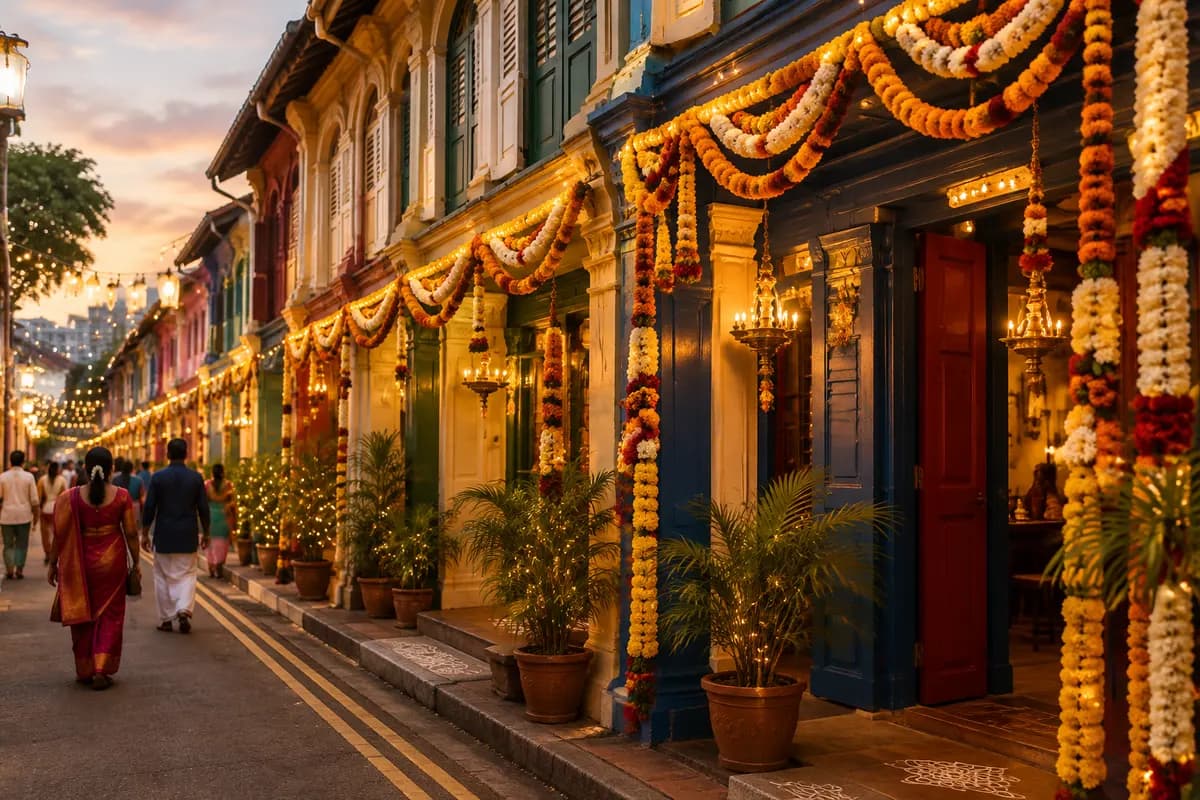
Campbell Lane, close to the Indian Heritage Centre, has long been associated with garland, festival and decorative goods, and it is among the most photogenic stretches during Deepavali. Dunlop Street brings in the Abdul Gaffoor Mosque, guesthouses and eateries, while Buffalo Road, Upper Dickson Road, Chander Road and Kerbau Road carry mixes of food, hardware, textiles and services. Race Course Road is known for its restaurants, including long-standing South Indian and fish-head curry eateries, and for the Buddha Gaya temple.
To the south and west, Little India Arcade and the Tekka Centre area form a distinctive sub-cluster. Little India Arcade is a restored block of conserved shophouses used as a lively mix of small shops and stalls, and Tekka Centre, the large wet market and hawker complex, anchors pedestrian flows around Buffalo Road and Serangoon Road. The Mustafa Centre area, a short distance along Syed Alwi Road toward Jalan Besar, is a major retail destination that draws large volumes of shoppers and affects nearby shophouse trading.
| Street / area | Character | Typical occupier |
|---|---|---|
| Serangoon Road | Main commercial spine with heavy pedestrian and bus traffic | Grocers, jewellers, textile, eateries, services |
| Campbell Lane | Festive, decorative goods, Indian Heritage Centre nearby | Garland, gift, cultural retail, small food outlets |
| Dunlop Street | Mosque, guesthouses and eateries | Food, hospitality, services |
| Buffalo Road / Kerbau Road | Tekka-side trade, wholesale and food | Eateries, provisions, hardware, services |
| Race Course Road | Restaurant strip and Buddha Gaya temple | Restaurants, bars, hospitality |
| Syed Alwi Road (Mustafa area) | Large-scale retail magnet toward Jalan Besar | Retail, services, hostels, F&B |
Uses and tenant mix: Little India shophouse rent and apartment-style stays
Enquiries for Little India shophouse rent and for shophouse apartment rental in Little India come from very different tenants. Commercial occupiers lease ground floors for trade or food, while some upper floors are approved for residential or serviced-stay use. The two are not interchangeable: renting a shophouse apartment is only lawful where the unit's approved use and any licensing for short-term stays permit it, so confirm both before signing.
The tenant mix in Little India is dominated by everyday trade and services. Grocery and spice shops, sweet makers, goldsmiths and jewellers, textile and sari shops, flower sellers, barbers, travel and remittance services and eateries are the core of the street. Many of these are owner-operators or long-running family concerns, and many cater to both local residents and the migrant-worker community that uses the area on Sundays and public holidays.
More recently, hostels, boutique hotels and a growing set of cafes, bars and creative spaces have joined the mix, particularly along Race Course Road, Dunlop Street and the quieter side lanes. These tenants rely less on the traditional customer base and more on tourism and younger local clientele. They typically need higher-spec fit-outs and different approvals, which makes the question of approved use for upper floors critical, especially for accommodation.
Residential or hostel-type use, serviced accommodation and food operations all intersect with different regulatory regimes. Before assuming a unit can be used for a particular purpose, confirm the approved use with URA and read the F&B licensing and change-of-use guide together with the commercial vs residential ABSD breakdown where residential components are involved.
The F&B and retail scene
Little India's food offer ranges from South Indian vegetarian restaurants and banana-leaf eateries to North Indian cuisine, Indian-Chinese dishes, Muslim-Indian eateries and hawker stalls at Tekka Centre. Prices tend to be accessible, volume is high, and customer loyalty is strong. This is a market where an operator's food quality, speed of service and price point matter more than décor, and where many successful businesses are decades old.
Retail is anchored by Mustafa Centre, a large department-style store that trades long hours, and by the dense run of independent shops along Serangoon Road and its side streets. Festival periods, particularly the weeks before Deepavali, drive peak trading for garlands, sweets, clothing, jewellery and decorative goods. Operators should plan inventory, staffing and cash flow around these peaks, and landlords should recognise that tenants' annual turnover is heavily concentrated.
Newer F&B concepts, including cafes and bars on Race Course Road and nearby lanes, attract a different crowd. They are more sensitive to the surrounding street environment, including crowding, noise and waste management, and they often pay more for fit-out. Applying for the right use and managing grease, exhaust and refuse is essential, as is checking whether neighbouring operators have established arrangements.
Little India conserved shophouse rules: URA status in practice
Little India is a gazetted conservation area, and its shophouses are graded and controlled under URA's conservation guidelines. This means façades, roof forms, five-foot ways, windows and decorative features are to be retained or restored using approved methods, and external works need approval. The painted façades that define the district's character are subject to controls on colour and finish, so a new owner cannot assume freedom to repaint or alter the street frontage.
Interior works are more flexible but still need approval where they affect structure, party walls or fire safety. Rear additions, roof extensions and attic conversions are allowed only within guideline limits, and the permissible extent depends on the building's grade and location. The cost of compliant restoration, using specialist contractors and traditional materials, should be built into acquisition budgets and not treated as an afterthought.
Read the URA conservation guidelines buyer manual for an explanation of grades, the approvals process and the role of a qualified person, and browse the conservation shophouses for sale hub to see how these controls interact with the market. Check the status of each individual lot rather than relying on area-level assumptions.
Little India fire safety: shophouse compliance for food and stays
Fire safety is a recurring theme in any discussion of a Little India fire shophouse risk profile, because dense terraces share party walls, kitchens sit beneath timber-floored upper storeys, and escape routes in narrow plots are limited. This is general guidance, not a statement about any particular building: owners and operators should expect to demonstrate compliant means of escape, fire detection and suppression appropriate to the use, and safe kitchen exhaust and electrical installations.
Practically, that means engaging a qualified person early, checking the fire safety history of the unit, confirming that any upper-floor accommodation or assembly use has the necessary approvals, and keeping five-foot ways clear of obstruction and storage. Insurers also look closely at these factors, so compliance protects both safety and insurability.
MRT, transport and walkability
Little India station, shared by the North East Line (NE7) and the Downtown Line (DT12), is the principal gateway and sits at the heart of the district, putting Serangoon Road, Campbell Lane and the Tekka area within a short walk. Farrer Park (NE8) serves the northern end near Race Course Road and Farrer Park hospital area. Rochor (DT13) offers a link toward Kampong Glam, and Bendemeer (DT23) and Jalan Besar (DT22) on the Downtown Line serve the Syed Alwi and Jalan Besar side.
Serangoon Road is a busy bus corridor, and many routes terminate or pass through the area. Cycling and walking are common, but pavements and five-foot ways are crowded at peak times, especially on Sundays and during festivals. For businesses, this means that foot traffic is plentiful but servicing is complicated: deliveries, waste collection and parking require careful planning, and on-street parking is limited and heavily used.
Connectivity to the CBD and to Orchard is strong via the North East and Downtown Lines, which is a benefit for hospitality and for offices serving creative or small-business tenants. Prospective occupiers should walk the street at different times, including a Sunday and a festival evening, to see how access and noise differ from a quiet weekday.
Price and rent context: how the area is positioned
Editorial review as of 5 November 2026; no figures quoted here—verify current transactions. This section describes how Little India is positioned in the shophouse market without citing prices, because values depend heavily on frontage, size, tenure, use, tenant profile and condition.
Qualitatively, Little India is a high-footfall, community-driven district. It does not rely on office demand and is less polished than the boutique clusters, which affects how some investors view it, but it has deep local demand, a strong cultural identity and unusual street-level activity. Value is driven by main-road frontage, proximity to the MRT and Tekka, approved use (F&B-capable and hospitality-capable buildings are valued differently), the lease profile, and the quality of the building's maintenance.
Evidence should come from primary sources and be compared like for like. The table below shows where to pull it.
| What to benchmark | Where to find it | Why it matters |
|---|---|---|
| Recent shophouse sales | URA REALIS (subscription) or URA SPACE; SRX and EdgeProp market data | Sets the range for comparable lots and tenure |
| Retail and F&B rents | URA commercial rental statistics; agents' achieved-rent data | Shows achievable income for the unit type |
| Tenure and encumbrances | SLA title search | Freehold and leasehold are priced differently |
| Approved use and grade | URA records; written confirmation from a qualified person | Determines permitted uses and financing |
| Tax and duties | IRAS property tax and stamp duty pages | Defines acquisition and holding cost |
| In-place tenancies | Tenancy agreements and rent roll | Sets current income, break rights and review terms |
Investment angle: Little India shophouse for sale and holding strategy
Everyday trade gives Little India shophouses steady demand, provided the building is maintained like the working asset it is.
The investment case for Little India relies on resilient local demand, strong visibility on main frontages and the district's cultural identity, which limits the risk of being displaced by transient trends. Conservation controls limit new supply of comparable buildings, and the area's accessibility by two MRT lines supports steady footfall. For investors who value stable cash flow from everyday trades rather than fashion-led tenants, it can be a coherent fit.
Equally, returns depend on managing the building actively. Older structures need regular maintenance, tenants may be small family businesses with limited covenant strength, and rent reviews can be sensitive to local trading conditions. Fit-out and restoration obligations should be clearly allocated in leases, and rent-free periods and reinstatement clauses should be modelled in advance.
Our guide to investing in Singapore conservation shophouses sets out an underwriting framework, while the freehold shophouses guide discusses how tenure affects value and exit. Browse current opportunities at commercial shophouses for sale and review leasing options at shophouses for rent.
Buying and renting checklist
Treat Little India as an operating-business market. Walk the street repeatedly, speak to neighbouring tenants, and verify that the use you intend is lawful and practical in the specific building. Engage a lawyer, a qualified person with conservation experience, and a valuer who understands the district.
Tenants should focus on the permitted use, the lease term, repair and restoration obligations, signage rights, service access and the extent of any rent review. Owners should plan for upkeep of the façade and five-foot way, and for regulatory compliance when leasing to food operators.
- Confirm tenure and encumbrances through an SLA title search.
- Confirm approved use, conservation grade and any previous approvals with URA.
- Commission a structural, roof, damp and pest survey.
- Review lease expiry profile, tenant covenant and rent review mechanics.
- Check feasibility for F&B: exhaust routing, grease management, fire safety and licensing.
- Check servicing: deliveries, waste collection and parking in the specific lane.
- Plan for festival peaks and quiet periods in your cash-flow model.
- Budget for façade and five-foot-way maintenance under conservation rules.
Risks to weigh
Tenant-quality risk is the most common issue. Many small traders operate on tight margins, and arrears or sudden closures can leave units vacant. Mitigate by using security deposits, bank guarantees and careful covenant checks, and by diversifying the tenant mix where you own more than one unit.
Building and regulatory risk follows. Older shophouses can have structural and moisture defects, and non-compliant alterations by previous owners or tenants can create enforcement exposure. Fire safety, ventilation and waste management are frequent compliance themes in high-density food strips, and owners may be asked to remedy defects.
Finally, environment risk. Crowding, noise and the occasional large-scale event can affect operations and neighbouring uses, and changes in policy affecting foreign workers or tourist flows could shift the customer base. None of these makes the district unsuitable, but they should be recognised in underwriting.
Nearby areas and how Little India compares
Immediately to the south, Kampong Glam has a more curated, tourist-facing and creative profile, while Jalan Besar to the east offers a quieter mix of cafes, hotels and creative uses, with lower pedestrian intensity. Our area guides for Jalan Besar and Petain Road and Balestier describe the fringe further out.
For CBD-adjacent options, consider Chinatown, Telok Ayer and Tanjong Pagar, which rely more on office workers, and the riverfront precincts of Boat Quay and Clarke Quay. Geylang has a different regulatory and use profile again.
Sources
Frequently Asked Questions
Are there Little India shophouses for sale?+
Listings appear occasionally and vary by tenure, grade and lease profile. Check title, approved use and conservation status first, and browse our commercial and conservation shophouses for sale pages.
How do I rent a shophouse on Race Course Road?+
Confirm the approved use, lease term, fit-out and repair obligations, and licensing for food or accommodation. A Race Course Road three-storey shophouse suits restaurants, but upper-floor use must be approved.
Can I rent a shophouse apartment in Little India?+
Only where the unit is approved for residential use and any short-stay licensing rules allow it. Upper floors of commercial shophouses are not automatically residential, so verify with URA and the landlord.
What fire safety rules affect Little India shophouses?+
Food and accommodation uses must meet fire safety requirements for escape routes, detection, suppression and kitchen exhaust. Engage a qualified person and check the unit's approvals before leasing or buying.
Is Little India a conservation area?+
Yes. Little India is a URA-designated conservation area, one of the historic districts conserved after the first conservation areas were gazetted in 1989. External alterations need approval and façade features are controlled.
Which MRT stations serve Little India?+
Little India (NE7 on the North East Line, DT12 on the Downtown Line) is the main station. Farrer Park (NE8) serves the north end, and Rochor (DT13) and Bendemeer (DT23) on the Downtown Line are nearby.
What are the main shophouse streets in Little India?+
Serangoon Road is the spine, with Campbell Lane, Dunlop Street, Buffalo Road, Kerbau Road and Race Course Road as the main supporting streets. Little India Arcade and the Tekka area form a distinct sub-cluster.
What uses suit Little India shophouses?+
Food and grocery retail, textiles, jewellery, services and small hospitality are typical. Any use must match the approved use of the unit, so verify with URA and a qualified person before buying or leasing.
Can I turn a Little India shophouse into a hostel or hotel?+
Only if the approved use and licensing allow it. Accommodation uses face specific planning, fire and licensing requirements, so confirm with URA and the relevant agencies before assuming conversion is possible.
Where can I verify current Little India shophouse prices and rents?+
Use URA REALIS or URA SPACE for transactions, URA rental statistics and SRX or EdgeProp market data. This page quotes no figures; editorial review as of 5 November 2026, so verify current transactions.