
D07 · Neighbourhood guide
Kampong Glam shophouses
A deep guide to Kampong Glam shophouses, the Malay-Muslim heritage quarter beside Bugis: how the streets evolved, who occupies them today, and what buyers and tenants should check before committing.
Kampong Glam shophouses sit in a conserved heritage quarter in postal district 07, anchored by the Sultan Mosque and bounded roughly by Beach Road, North Bridge Road, Jalan Sultan and Ophir Road. Its shophouses suit boutique retail, cafes, bars, design studios and small hospitality, and the whole precinct sits within URA conservation controls that govern façades, uses and works.
Editorial review as of 5 November 2026. Related: Kampong Glam · D07–08 City Fringe · all neighbourhoods.
| Postal district | D07 (Bugis / Beach Road / Rochor fringe) |
|---|---|
| Nearest MRT | Bugis (EW12 East West Line, DT14 Downtown Line); Nicoll Highway (CC5 Circle Line) and Bras Basah (CC2) are further walks; Rochor (DT13) and Jalan Besar (DT22) sit on the Downtown Line nearby |
| Heritage anchors | Sultan Mosque (National Monument), Istana Kampong Gelam (Malay Heritage Centre), Bussorah Street, Arab Street, Haji Lane |
| URA status | Designated conservation area; the first conservation areas were gazetted in 1989 and Kampong Glam is one of the historic districts brought under conservation |
| Typical building form | Two- and three-storey shophouses, many with five-foot ways, timber shutters and Early/Transitional/Late-style façades |
| Typical uses | Boutique retail, textiles and fragrance, F&B, bars, creative studios, small offices, selected hospitality |
| Tenure | Mixed; confirm freehold, 99-year or other leasehold title for each lot via a title search |
| Who buys or rents | Owner-operators, family offices, F&B groups, fashion and design brands, long-hold investors |
Why shophouses in Kampong Glam matter to buyers and tenants
In Kampong Glam the street is the brand: a shopfront here borrows its reputation from the lane around it.
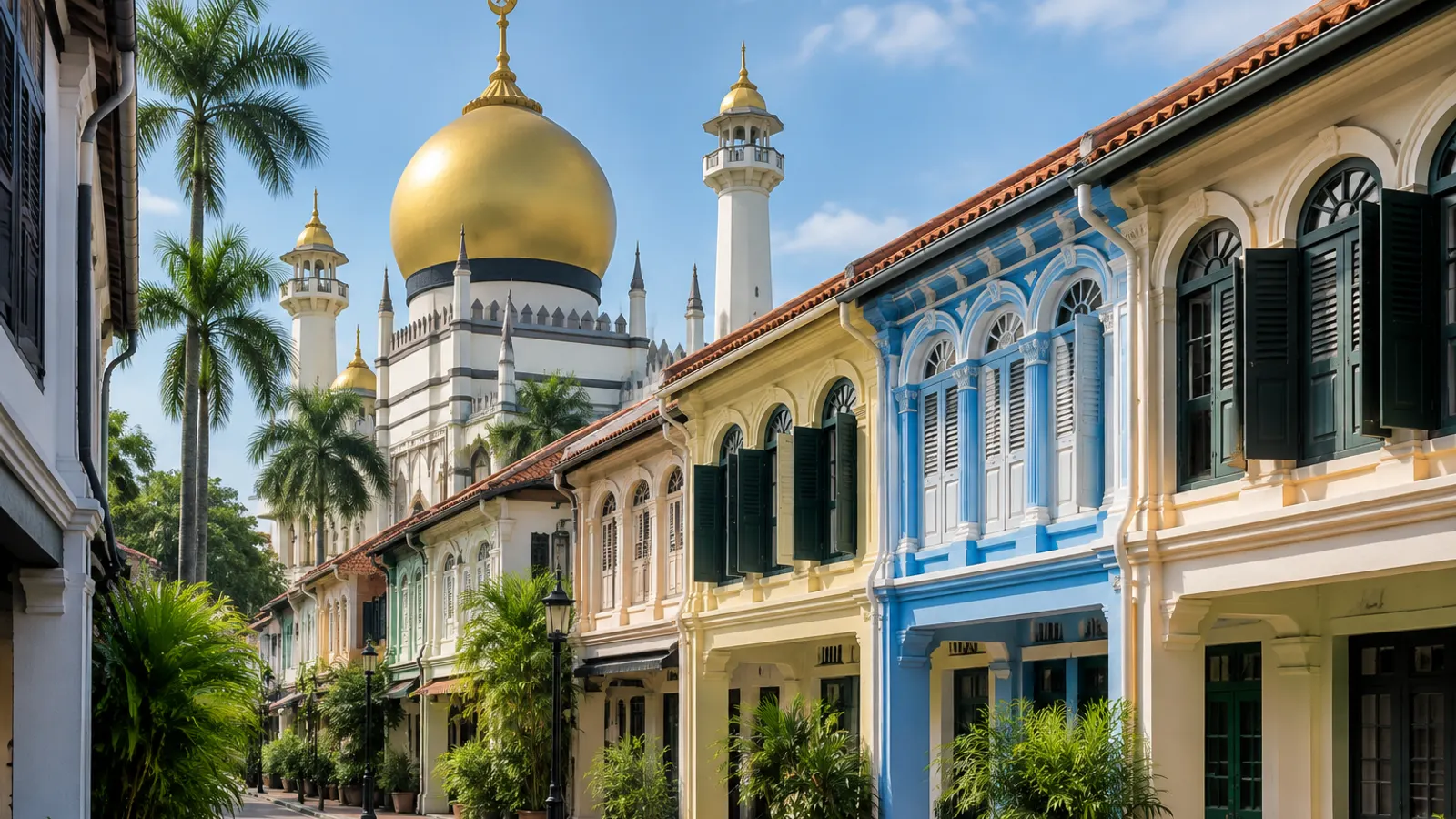
Kampong Glam is one of the few places in Singapore where a heritage identity, a high-footfall urban setting and a genuinely varied commercial street grid sit within a few minutes of each other. It is small, walkable and unmistakable: the golden dome of the Sultan Mosque is visible at the end of Bussorah Street, textile merchants line Arab Street, and a short walk away Haji Lane packs independent labels, bars and murals into a lane only a few metres wide.
For an occupier this concentration is the product. A shop or restaurant here borrows from the neighbourhood's reputation as much as from its own brand, and customers arrive with an intent to explore on foot rather than pass through. For an investor, the same characteristics mean the asset class behaves more like a destination retail street than a generic commercial block, with value that tracks tourism, local leisure spending and the strength of the surrounding F&B cluster.
This page is written as an editorial primer. It explains the history that created the building stock, the streets that matter, the uses that work, how URA conservation rules shape what you can do, and how to approach valuation without relying on quoted figures. It sits beside our broader Kampong Glam area overview and the D07–08 City Fringe district guide, and should be read together with the URA conservation guidelines buyer manual.
History: from Malay royal seat to conserved precinct
The area's modern history begins with the 1819 founding of Singapore as a British trading post and the 1822 town plan associated with Stamford Raffles, which set aside this district east of the Singapore River for the Malay community and the Sultan. Sultan Hussein Shah, who had signed the 1819 agreements, and his household settled here, and the quarter became the political and cultural centre of the island's Malay and wider Muslim population. The name is commonly linked to the gelam tree (Melaleuca), whose bark was used in boat caulking and traditional medicine, although such etymologies in Singapore are best treated as traditional accounts rather than settled fact.
Over the nineteenth century the district grew into a cosmopolitan trading quarter. Arab, Malay, Javanese, Bugis and Indian Muslim traders established businesses, and Arab merchants in particular became prominent landlords and traders, which is the origin of the Arab Street and Bussorah Street names. Pilgrimage-related trade, textile dealing, perfume and spice shops, printing and publishing in Malay and Jawi all concentrated here. The Istana Kampong Gelam, built in the 1840s for Sultan Ali, remains the principal royal-era building and today houses the Malay Heritage Centre.
The current Sultan Mosque was completed in 1932 to the design of the architect Denis Santry of Swan & Maclaren, replacing an earlier mosque on the site; it was gazetted as a National Monument in 1975. In the late twentieth century, urban renewal threatened many central shophouse districts. The 1989 conservation programme brought Kampong Glam, together with Chinatown, Little India, Boat Quay and others, under URA conservation, and later restoration and public-realm works, including the pedestrian treatment of Bussorah Street, gave the precinct its current character.
- 1819–1822: British settlement and town plan allocate the area to the Sultan and the Malay-Muslim community.
- 1840s: Istana Kampong Gelam completed for Sultan Ali; today the Malay Heritage Centre.
- 1932: present Sultan Mosque completed; National Monument status in 1975.
- 1989: conservation framework first applied to historic districts including Kampong Glam.
- Late 1990s onwards: restoration, pedestrianisation of selected lanes, and the rise of Haji Lane as a creative destination.
Kampong Glam shophouses typology: streets, façades and stock
Anyone researching an Arab Street shophouse, whether for a purchase, a lease or simply to understand the district, should start with typology. The shophouse on Arab Street is usually a narrow-fronted terrace with a covered five-foot way, a shopfront at ground level and living or storage space above, and the same basic form repeats across the precinct with variations in ornament, height and age.
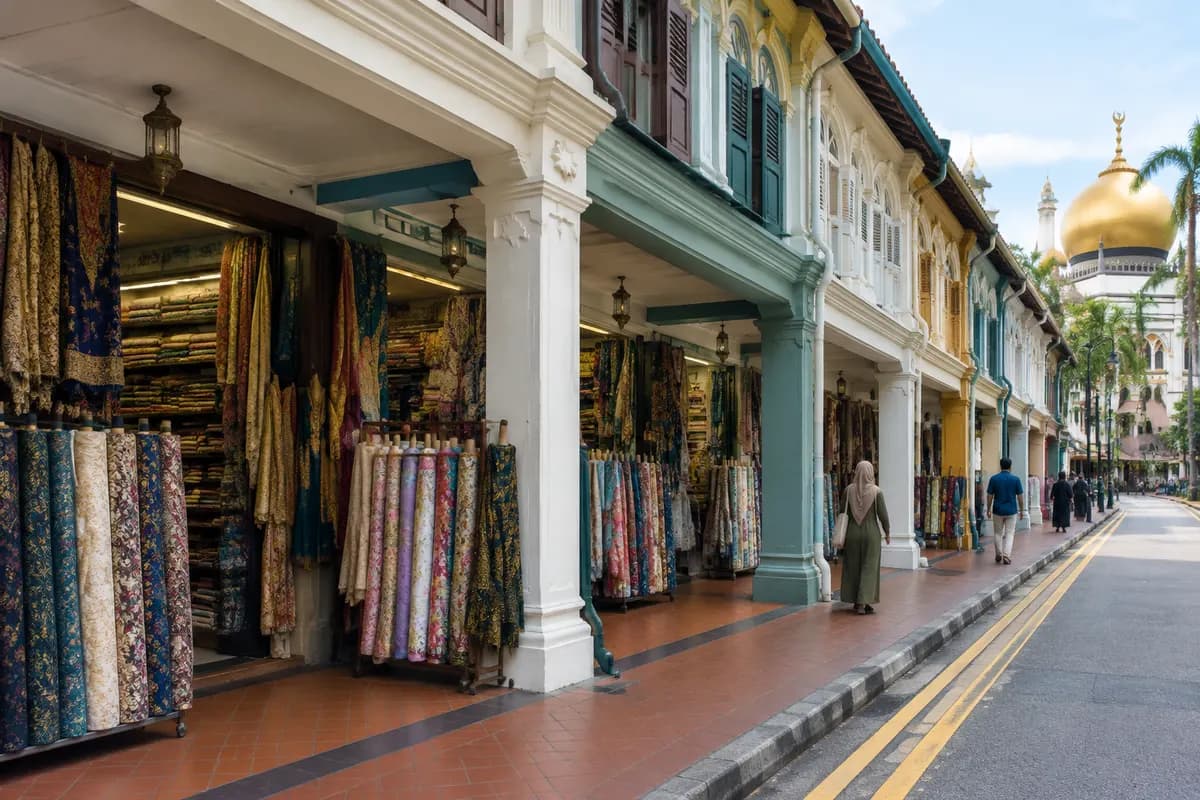
Arab Street is the commercial spine, historically a textile street and still known for fabrics, batik, rugs, baskets and Middle Eastern goods. Its shophouses are generally two- to three-storey terraces with continuous five-foot ways, which means the first-floor frontage is a public walkway and retail display space that is part of the building's legal and visual form. Bussorah Street, running toward the mosque, is the most photographed axis; its restored terraces now hold cafes, restaurants serving Middle Eastern and Turkish menus, and gift and craft retailers.
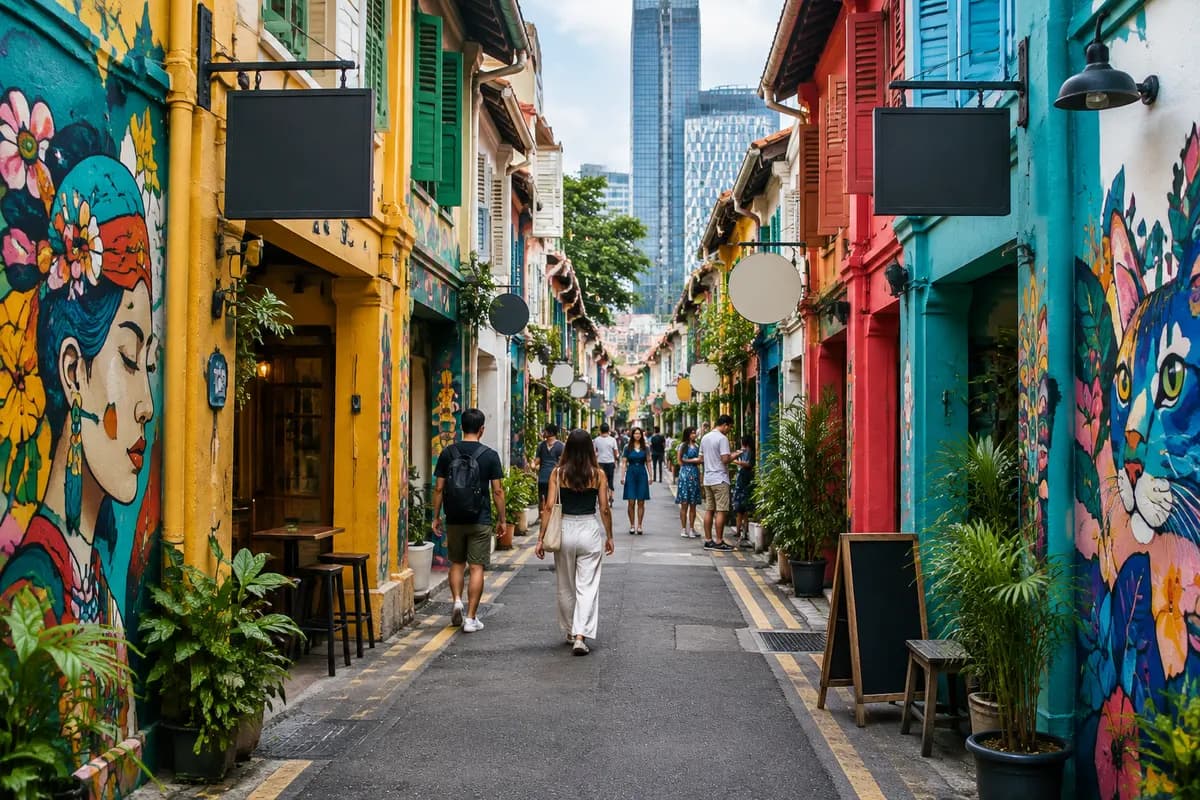
Haji Lane and the adjoining Bali Lane, Muscat Street and Baghdad Street form the denser, more experimental fabric. Frontages here are narrow, plots are shallow, and units are well suited to small-format brands, bars with upstairs terraces and independent boutiques. Baghdad Street and Muscat Street carry a quieter mix of restaurants, guesthouses and specialist traders, while Sultan Gate and Kandahar Street bring in the Istana precinct and a more residential-institutional character. Beach Road forms the eastern edge toward the Bugis side and has a wider mix of larger conserved blocks, hotels and offices alongside shophouses.
Architecturally, the stock spans the broad conservation typologies used by URA: earlier simpler façades with timber windows and tiled roofs, more ornamented Transitional and Late-style terraces with decorative pilasters and plasterwork, and some Art Deco and Early Modern buildings from the interwar and postwar years. Party walls, narrow floor plates, long rear air-wells and shared structural elements are common, so internal layouts are tightly constrained. A surveyor's report on structure, roof, damp and previous alterations is not optional on any purchase.
| Street / lane | Character | Typical occupier |
|---|---|---|
| Arab Street | Textile and gift spine, steady pedestrian traffic | Fabric, souvenir, apparel, dining |
| Bussorah Street | Pedestrian axis toward the Sultan Mosque | Cafes, Middle Eastern restaurants, craft retail |
| Haji Lane / Bali Lane | Narrow creative lanes, murals, small units | Independent labels, bars, studios |
| Baghdad Street / Muscat Street | Quieter lanes, mixed dining and trade | Restaurants, specialist retail, hospitality |
| Beach Road (Kampong Glam stretch) | Wider road, hotels and larger conserved blocks | Hospitality, offices, F&B |
| Jalan Sultan / Sultan Gate | Istana precinct and institutional edge | Offices, services, heritage-linked uses |
Uses and tenant mix
The traditional core uses are retail and trade. Textile, perfume, carpet, rattan and religious-goods shops remain part of the identity, and a number of long-running family businesses still operate. On top of that traditional base, the last two decades have layered cafes, restaurants, bars, concept stores, tattoo and barber studios, creative offices and boutique accommodation. The result is a tenant base that mixes operators with decades of local standing and newer brands that value an Instagrammable setting.
That mix matters because different tenants behave differently as landlords' counterparties. Established traders may hold older leases, understand the building and want continuity; newer F&B groups bring higher fit-out budgets but also higher turnover risk, and tenant covenant strength varies widely. Upper floors are used for storage, studios, small offices, or in some cases licensed hospitality, but each use must be consistent with the approved use of the premises, a point covered in depth in our F&B licensing and change-of-use guide.
Residential use is a separate question. Some Kampong Glam shophouses are approved for residential use on the upper floors and some are strictly commercial, and the difference affects financing, stamp duty treatment and buyer eligibility. Confirm the approved use on the URA record before assuming any conversion is possible, and read the commercial versus residential ABSD breakdown if you are weighing a mixed-use building.
- Heritage trade: textiles, perfume, rugs, religious and gift items.
- Hospitality: cafes, Middle Eastern and Southeast Asian restaurants, bars, boutique stays.
- Creative and lifestyle: design studios, independent fashion, barbers, tattoo and art spaces.
- Support uses: small offices, storage, services, and upper-floor studios.
Haji Lane shophouse scene: F&B, retail and mural art
A Haji Lane shophouse is typically a slim, shallow unit whose value to a tenant lies in visibility and neighbours rather than floor area. The mural art along Haji Lane, refreshed over time by artists, is part of the draw: it turns an ordinary service lane into a photographed backdrop and encourages visitors to linger, which helps bars, boutiques and cafes whose trade depends on browsing. Murals on a building should always be cleared with the owner and, where visible from the public realm, with the relevant authorities.
Kampong Glam's food identity is anchored in Malay, Arab, Turkish and wider Middle Eastern cooking, with a layer of contemporary cafes and cocktail bars. Bussorah Street and Arab Street support terrace dining oriented toward the mosque view, while Haji Lane skews toward bars and late-evening socialising. The Ramadan season, including the bazaar activity and the daily rhythm around breaking of fast, changes foot traffic patterns, trading hours and the product mix, and any operator should plan around it rather than treat it as an anomaly.
Retail here is destination-led. Visitors browse for fabrics, fragrance, accessories and gifts, and locally oriented independent brands favour Haji Lane for its density of fellow creatives. The cost of that visibility is churn: leases in the narrowest lanes can turn over frequently, and the trade between rent, fit-out and turnover needs careful modelling. Because the precinct is also a tourist stop, weekday-weekend and seasonal profiles can differ from those of an office-fed street such as Telok Ayer.
Any F&B conversion needs approval for the intended use, a compliant ventilation and grease-management strategy, fire safety and food licensing, and consideration of neighbours in a tightly packed lane. Noise-sensitive uses next to residential units and the mosque environment call for particular care. Alcohol-serving venues should check licensing conditions and the cultural context of their location before committing to a lease or purchase.
URA conservation status and what it means in practice
Kampong Glam is a gazetted conservation area, and individual buildings are graded and controlled under URA's conservation guidelines. The 1989 gazettal of the first conservation areas set the model: façades, roof forms, five-foot ways, timber windows and many original features are to be retained or restored in accordance with approved methods, and external alterations require approval. Interiors have more flexibility than façades but structural changes, additions and rear extensions are tightly controlled.
For a buyer this translates into several concrete checks: the building's conservation status on the URA record, the approved use and any restrictions, the permissible extent of rear and upper additions, and the requirements for façade restoration. The responsibility for restoration quality lies with the owner, and the cost of specialist craftsmen, traditional lime-based materials and compliant mechanical and electrical routing can be significantly higher than a standard commercial fit-out.
Do not assume an extension or additional storey that a neighbour has built is available to you: past approvals reflect the rules of their time, and URA's current guidelines may differ. The URA conservation guidelines buyer manual walks through the grades, the approval process and the typical consultant team, while our conservation shophouses for sale hub explains how those controls interact with the market.
MRT, Bugis link and walkability
Demand for a shophouse in Bugis and for a shophouse for rent Bugis-side often spills into Kampong Glam, because the two are a few minutes apart on foot. Beach Road and the Bugis edge offer easier vehicle access and slightly larger blocks, while the Kampong Glam lanes behind them trade on atmosphere; many occupiers compare both before choosing.
Bugis station (EW12 on the East West Line and DT14 on the Downtown Line) is the principal gateway, and from there the walk to Arab Street or Haji Lane is short and mostly sheltered or pedestrianised through the Bugis Junction and Bugis Street links. Bugis also connects to the broader retail and hotel belt of Victoria Street and Bras Basah. On the Downtown Line, Rochor (DT13) and Jalan Besar (DT22) offer alternative approaches, and Nicoll Highway (CC5) on the Circle Line serves the Beach Road end.
Within the precinct, the experience is overwhelmingly on foot. Vehicle access to lanes such as Bussorah Street is limited, and loading and servicing are managed through designated times and bays, which matters for F&B operators who need deliveries and waste collection. Parking is constrained; nearby multi-storey and public car parks are the practical option, and tenants should factor staff commuting by MRT or bus into their site decision.
Walkability is a major value driver, but so is the dispersion of the customer base. Tourists, office workers from the Bugis and Bras Basah side, residents of the surrounding districts and religious visitors on certain days all use the area differently. A prospective occupier should observe the street at several times of day and across a weekend and a major festival period before committing, rather than relying on a single visit.
Price and rent context: how the area is positioned
Editorial review as of 5 November 2026; no figures quoted here—verify current transactions. This section explains how the market is positioned without citing prices, because shophouse values vary enormously by lot size, tenure, grade, use, condition and lease profile, and published averages can mislead.
Qualitatively, Kampong Glam sits in the city-fringe tier of conservation shophouses: it generally does not command the CBD-style office rent logic of Telok Ayer or Tanjong Pagar, but it benefits from sustained pedestrian demand, a strong brand and limited supply of comparable heritage streets. Value is driven by frontage on the best lanes, the approved use (F&B-capable units are typically valued differently from retail-only or office-only), the length and strength of existing leases, tenure, and the condition of the structure and façade.
Evidence should always be drawn from primary sources, and compared like for like. The table below lists what to benchmark and where to find it.
| What to benchmark | Where to find it | Why it matters |
|---|---|---|
| Recent shophouse sale transactions | URA REALIS (subscription) or URA SPACE for published data; SRX / EdgeProp for market commentary | Establishes the range for comparable lots and tenure |
| Rental levels for retail and F&B units | URA rental statistics for commercial space; agents' asking and achieved-rent data | Shows the income the building can realistically support |
| Tenure and land details | SLA title search via INLIS / SLA e-services | Freehold, 99-year and other leaseholds are priced differently |
| Approved use and conservation status | URA records and written confirmation from a qualified person | Determines what the buyer can do and how it can be financed |
| Property tax and stamp duties | IRAS property tax and stamp duty pages | Determines holding cost and acquisition cost |
| Existing lease terms | Tenancy agreements and rent roll | Sets the in-place income, break rights and review mechanisms |
Investment angle: Arab Street shophouse for sale and holding strategy
Scarcity supports the story, but only disciplined underwriting of upkeep and lease risk turns it into returns.
Buyers searching for an Arab Street shophouse for sale are usually weighing three things: frontage on a proven pedestrian lane, a lease profile that is not about to expire, and whether the approved use supports F&B or hospitality. Listings in the precinct are infrequent, so patience and a ready team of lawyer, qualified person and valuer matter more than speed.
The investment case for Kampong Glam rests on scarcity, a durable heritage brand and the flexibility of mixed retail and hospitality use. There is a finite stock of conserved shophouses and the conservation framework restricts new supply of the same character. Foot traffic is also less dependent on the office cycle than in the CBD, though it is more exposed to tourism and leisure-spending swings.
Against this, operating risks are real. F&B and fashion tenants can face margin pressure, short-lease turnover and fit-out cycles, and building maintenance on older structures can absorb a meaningful share of rental income. Buyers should model downtime between leases, restoration capital expenditure and the cost of regulatory approvals. Our guide to investing in Singapore conservation shophouses sets out an underwriting framework, and the freehold shophouses guide explains how tenure influences value and exit.
Stamp duty is a material part of acquisition cost. Commercial and residential shophouses are treated differently for ABSD and for loan-to-value rules, and foreign and entity buyers have specific exposures, so the commercial vs residential ABSD breakdown should be read before any offer. Current opportunities can be browsed under commercial shophouses for sale and conservation shophouses for sale.
Buying and renting checklist
A good purchase or lease in Kampong Glam is decided in the documents rather than the photographs. Start with title, approved use and conservation grade, then move to structure, tenancy and the practicalities of operating in a pedestrian lane. Engage a lawyer, a qualified person such as an architect or engineer familiar with conservation works, and a licensed valuer with heritage experience.
If you are a tenant, the key questions are different: what use is approved, who bears restoration and repair obligations, how are grease, noise and signage handled, and what are the lease term, rent review and reinstatement clauses? Our shophouses for rent page lists leasing considerations in more detail.
- Confirm tenure and any encumbrances through an SLA title search.
- Confirm approved use, conservation grade and any prior approvals with URA and a qualified person.
- Commission a structural, roof and damp survey; check party-wall conditions.
- Review the lease roll, expiry profile, rent review clauses and tenant covenant.
- Check F&B feasibility: grease trap, exhaust routing, fire safety and licensing.
- Check servicing: deliveries, waste, loading times and any pedestrianisation rules.
- Budget for façade restoration and compliance works, not just purchase price and stamp duty.
- Visit at different times of day and across Ramadan and non-Ramadan periods.
Risks to weigh
Concentration risk is the first one. Kampong Glam's performance depends on a few hundred metres of streets and a relatively narrow set of tenant types. A shift in visitor patterns, a major road or construction project, or a sudden fall in tourist arrivals can affect trading across the precinct at once. Diversified rent rolls and longer leases mitigate this, but only partly.
Building risk follows. Older timber, brick and lime-plaster structures need continuing maintenance, and hidden defects such as roof leaks, termite damage or rising damp are common. Heritage compliance adds cost and time, and mistakes in restoration can lead to enforcement and abortive expense. Regulatory risk, including changes to approved uses or licensing policies, also deserves attention.
Finally, there is cultural and operational sensitivity. The district is both a commercial area and a living religious and community centre, so tenants and owners benefit from respecting the surrounding context in signage, events and operating hours. Brand fit with the precinct's identity is part of the long-term durability of rents.
Shophouse in Bugis and nearby areas: how Kampong Glam compares
Next door, Little India offers a different cultural character and a heavier foot-traffic and weekend-crowd profile, while Jalan Besar provides a more local, creative and lower-key shophouse environment within a short ride. The adjoining Bugis and Beach Road fringe is covered in our area guides at Bugis and Beach Road.
Across the river, Chinatown, Telok Ayer and Tanjong Pagar have a stronger office and lunch-hour base, whereas Boat Quay and Clarke Quay are riverfront nightlife precincts. Geylang sits further east with a distinct tenure and use profile. Choosing between them is largely a question of tenant type, hours of operation and capital budget.
Sources
Frequently Asked Questions
Are there Arab Street shophouses for sale or rent?+
Occasionally. Arab Street shophouse listings are infrequent and vary by tenure, use and lease profile. Browse our conservation and commercial hubs, and verify title, approved use and conservation status before making an offer.
What is special about a Haji Lane shophouse?+
Haji Lane units are narrow, shallow terraces in a pedestrian-scale lane known for independent shops, bars and mural art. Their appeal is visibility and a creative cluster rather than floor area.
Is there a shophouse for rent near Bugis?+
Yes, Kampong Glam and the Beach Road edge near Bugis MRT (EW12 / DT14) have periodic shophouse rental opportunities. Compare approved use, lease length, fit-out obligations and servicing access; see our shophouses for rent page.
Is Kampong Glam a conservation area?+
Yes. Kampong Glam is a URA-designated conservation area, one of the historic districts brought under conservation after the first conservation areas were gazetted in 1989. Façade, roof and many external features are controlled, and works need approval.
Which MRT stations serve Kampong Glam?+
Bugis (EW12 on the East West Line, DT14 on the Downtown Line) is the main station. Rochor (DT13) and Jalan Besar (DT22) on the Downtown Line and Nicoll Highway (CC5) on the Circle Line are alternative approaches.
Can I open a restaurant or bar in a Kampong Glam shophouse?+
Only if the unit's approved use permits it or change of use is granted. You also need food or liquor licensing, compliant exhaust and grease management, and fire safety approval. Check with URA and a qualified person before committing.
Are Kampong Glam shophouses freehold?+
Tenure is mixed and varies lot by lot. Confirm whether a particular shophouse is freehold, 99-year or another leasehold through an SLA title search rather than assuming from the address.
What are the main streets for shophouses in Kampong Glam?+
Arab Street, Bussorah Street, Haji Lane, Baghdad Street, Muscat Street and the Beach Road stretch are the core. Each has a different tenant mix, from textiles and cafes to bars and boutique stays.
Where can I find current Kampong Glam shophouse prices and rents?+
Use URA REALIS or URA SPACE for transactions, URA rental statistics, and market data from SRX or EdgeProp. This page quotes no figures; editorial review as of 5 November 2026, so verify current transactions.
Do I pay ABSD on a Kampong Glam commercial shophouse?+
Commercial properties are generally treated differently from residential for ABSD, but mixed-use or residential-approved shophouses may attract it. Check IRAS rules and our ABSD guide before making an offer.