
D09–10 · Orchard
Emerald Hill shophouses
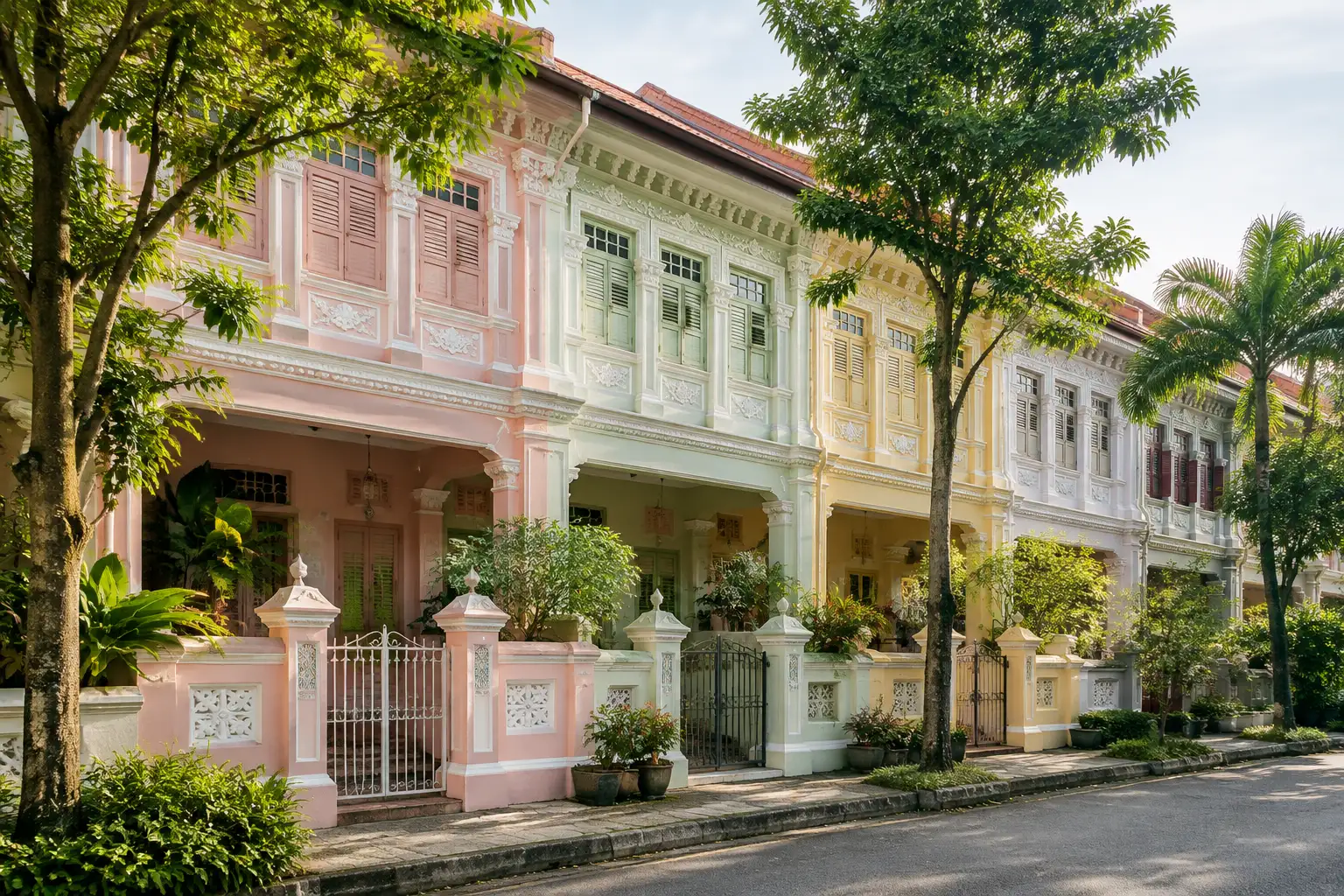
A dead-end conservation hill of Peranakan terraces one block behind Orchard Road — bought as homes and scarce heritage, not as restaurant shells.
The short answer
Emerald Hill is a gazetted conservation street of early twentieth-century Peranakan terraces and shophouse-style houses, set one block behind Orchard Road in District 9. It is a mainly residential precinct, reached from Somerset or Orchard MRT, and is bought for prestige living and scarcity rather than retail or F&B income.
Emerald Hill at a glance
- Postal district
- District 9 (Orchard), within the D09–10 Orchard hub
- Conservation status
- Emerald Hill Conservation Area (URA); façade, roofscape and streetscape controls apply
- Typical stock
- Two- and three-storey terraces and shophouse-style houses with five-foot-ways, built roughly 1900s–1930s
- Dominant use
- Residential; limited commercial use around the Orchard Road mouth
- Nearest MRT
- Somerset (NS23) and Orchard (NS22), both a short walk
- Tenure
- Verify per lot; many terraces are freehold, but never assume
- Stamp duty lens
- Residential: BSD plus ABSD where applicable, not the full-commercial no-ABSD pathway
- Best for
- Owner-occupiers, long-hold heritage buyers, trophy-home investors
Emerald Hill at a glance
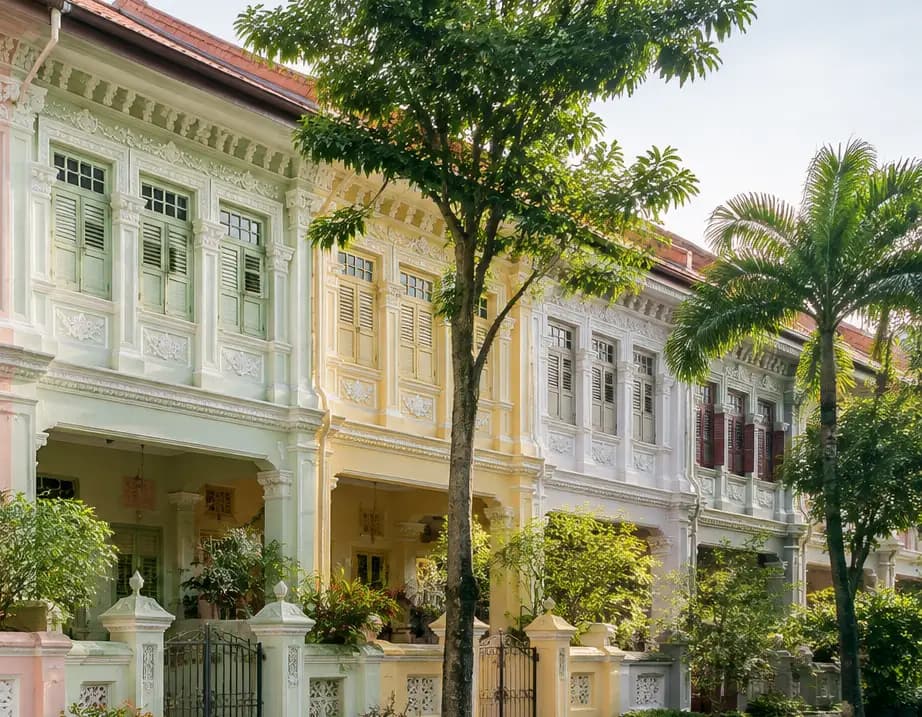
Emerald Hill Road climbs gently from the Orchard Road corner beside Peranakan Place and ends in a quiet residential loop. Along both sides run continuous rows of colourful, ornately decorated terraces. If you picture a Singapore "Peranakan shophouse" — pastel plasterwork, glazed ceramic tiles, carved timber shutters, a covered five-foot-way — Emerald Hill is among the most complete places in the city where that picture still holds.
For search purposes the phrase "Emerald Hill shophouses" is common, and it is worth being precise: much of the stock is better described as conserved terrace houses built in shophouse-derived styles. They were designed as family homes rather than ground-floor trading units. That difference drives everything that matters to a buyer — zoning, stamp duty, financing, and who your realistic exit buyer is. Our wider Emerald Hill area briefing and the District 09–10 Orchard hub cover the same ground at a summary level; this page goes deeper.
History of Emerald Hill
Before urban development, the land behind today's Orchard Road was part of the area's nineteenth-century plantation and orchard landscape, which is where Orchard Road takes its name. As the town spread outward, estates on the hill were subdivided and sold in plots. Over the first decades of the twentieth century the hill filled with terraces commissioned largely by Peranakan and other Straits Chinese families, who prized the elevated, breezy site close to town.
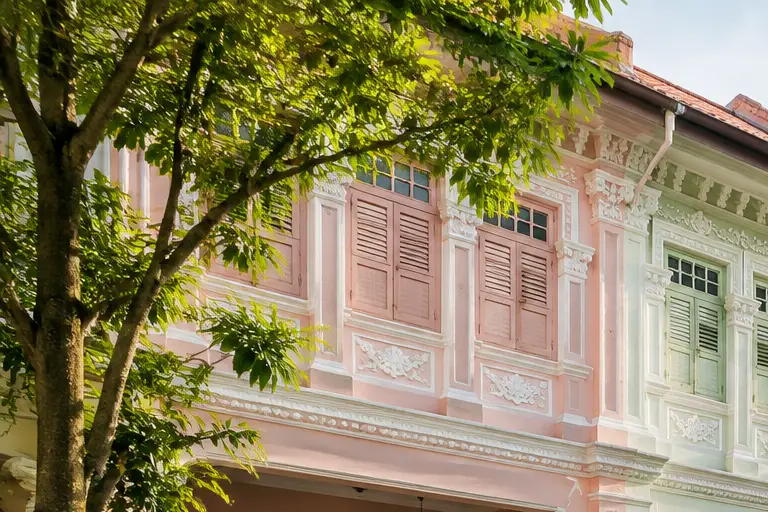
The architecture shows a progression. The earlier houses lean towards the ornate Early and Transitional shophouse idiom — heavy decoration, timber fanlights, richly glazed tiles. Later rows, from the 1920s and 1930s, show the cleaner geometry associated with Late Shophouse and Art Deco influences, with more restrained pilasters and simpler parapets. Walking the hill from bottom to top is effectively a short course in how Singapore's terrace vernacular evolved.
Redevelopment pressure along Orchard Road in the later twentieth century put the hill at risk. Emerald Hill was brought under URA conservation in the late 1980s, which is why the streetscape survives while much of the surrounding area turned into malls and towers. The conservation decision is the single most important fact about the hill: it fixed the supply of terraces permanently and made restoration, not rebuilding, the only route for owners.
Streets, shophouse stock and architectural styles
The conservation area is compact. Emerald Hill Road is the spine, with short side approaches and the Orchard Road frontage at its mouth. Because the street is a dead end, through traffic is minimal and the upper part feels private, almost village-like, compared with the retail intensity a minute away.
Typical features you should expect to see, and expect URA to care about, include:
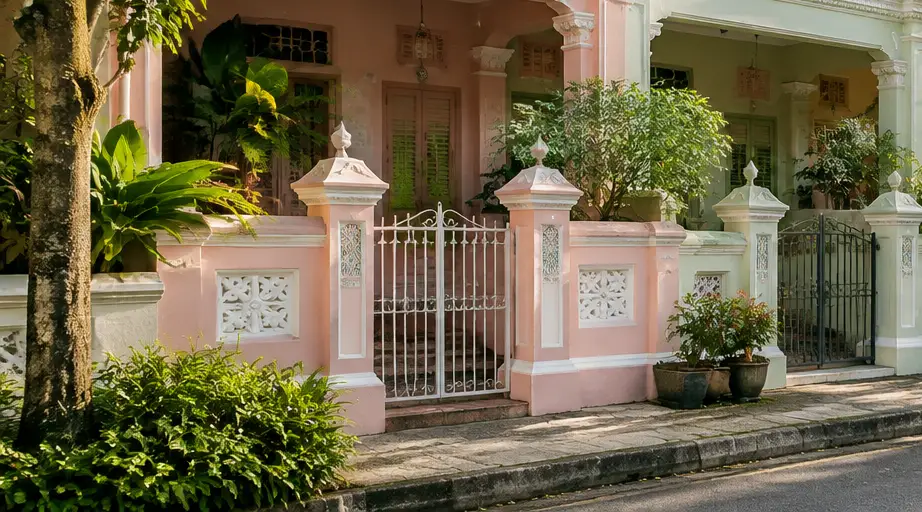
- Continuous five-foot-way colonnades along the front of the terraces, which are conserved as public-private circulation space.
- Pitched clay-tile roofs with traditional ridge profiles; altering pitch, material or visible form is tightly regulated.
- Timber louvred shutters, fanlights and carved or moulded decorative panels on upper-storey façades.
- Glazed ceramic wall and floor tiles, which are often original and costly to match when damaged.
- Party walls shared along the row, which means structural and neighbour-consent issues arise in almost any serious renovation.
- Rear extensions of varying vintage; the legal, approved extent of these is a frequent diligence finding.
Typical uses on Emerald Hill
Residential occupation is the default. Most terraces are lived in by owners or leased to tenants as high-end homes. At the Orchard Road mouth, the mix shifts towards the commercial edge — a handful of units trade as hospitality or retail on the back of Orchard's footfall — but that is the exception, and it should not be extrapolated up the hill.
Customer-facing F&B, retail or boutique-hotel use inside the residential portion generally requires URA permission for change of use and is often resisted by planning policy and neighbours alike. If your plan is a restaurant, start from the F&B licensing and change-of-use guide and realistically compare Club Street or Tras Street, where commercial zoning is the norm.
URA conservation status and what it means for owners
Emerald Hill is a designated Conservation Area. In practice that means front façades, the five-foot-way, roof form and key architectural elements are to be retained and restored to the original design, while interiors and rear portions can be adapted within approved parameters. Restoration works require URA approval and typically need a qualified professional team with conservation experience. Our URA conservation buyer manual explains the approval path and typical pitfalls.
Two buyer-side consequences are worth stating plainly. First, conservation protects supply: nobody can add new terraces to the hill, so scarcity is structural. Second, it caps flexibility: an owner who dislikes a roof line, a façade colour restriction or a mandated retention cannot simply override it. Budget for specialist trades, longer timelines and the cost of conservation-grade materials.
Transport and MRT access
Emerald Hill's practical strength is its position. Somerset MRT (North-South Line) and Orchard MRT (North-South and Thomson-East Coast Line interchange) are both within an easy walk, and Dhoby Ghaut's interchange sits a short distance beyond. From there the network reaches the CBD, the airport via interchange, and most of the island. Orchard Road bus services run along the frontage.
Driving is straightforward in principle but parking along the hill is limited and residents' priorities apply. If you buy a terrace without a usable car porch, the daily reality is taxi, ride-hail and MRT. Confirm parking arrangements per lot. Line names and station codes can change as the network expands, so check the LTA map for current interchange details before you promote any listing.
Price and rent context
As of November 2026 we do not publish a headline price per square foot for Emerald Hill, because terraces are individual, irregular lots with very different land areas, conditions and renovation histories. Averages hide more than they reveal. What can be said with confidence is directional: whole terraces have generally been reported as eight-figure acquisitions, they trade infrequently, and a restored, well-located interior typically commands a premium over a tired one.
To get evidence rather than anecdote, pull recent caveats and transactions from URA's REALIS or the public URA transaction search, filter on the Emerald Hill postal range, and read the land area, tenure and date for each. Rental evidence is thinner: leasing, when it occurs, behaves like prime residential rather than like commercial shophouse rent, so compare against high-end Orchard-area residential, not Club Street F&B. We deliberately avoid quoting yields on this precinct; the lifestyle-versus-yield trade-off is explained in the 2026 investing pillar.
Dining, retail and lifestyle around the hill
The immediate residential street is quiet by design. The lifestyle value is in what surrounds it: the Orchard Road retail belt, Somerset's cinemas and malls, the Istana Park and Fort Canning corridor, and the Peranakan Place frontage at the base. Evening noise from Orchard Road can reach the lower end of the hill, while deeper lots are noticeably calmer. We make no claims about which individual restaurants or bars are trading at any time, since tenancies change quickly.
Schools, hospitals and embassies are nearby in the wider Orchard–Newton–River Valley area, which helps explain the steady owner-occupier demand. For comparison with other heritage lifestyle pockets, see our briefings on Cairnhill and Joo Chiat.
Investment and living angle
Treat Emerald Hill as a lifestyle-and-scarcity asset. The thesis is permanent supply, a prestigious address, and a deep pool of wealthy owner-occupiers, not income. A buyer who needs a commercial yield will find the numbers difficult because the terraces are priced as homes and rent as homes.
The tax and finance profile is residential. Buyer's Stamp Duty applies, and Additional Buyer's Stamp Duty may apply depending on your residency and number of properties; rates and rules are set by IRAS and change, so confirm them before committing. Our commercial versus residential ABSD breakdown explains why the "no ABSD on commercial" story does not transfer here. Foreign-buyer rules for landed or residential property also differ from commercial-zoned shophouses, so take legal advice on eligibility early.
Holding costs are non-trivial: conservation-grade maintenance, termite and damp management in old timber and plaster, and insurance for heritage fabric. Many long-hold owners treat restoration as an intentional capital project rather than a repair expense.
Due-diligence checklist for an Emerald Hill terrace
Before you make an offer, work through the following.
- Confirm tenure, land area and any easements through an SLA title search.
- Check Master Plan zoning and conservation guidelines for the exact lot on URA SPACE.
- Obtain approved plans and compare them with what is physically built, especially rear extensions and attic works.
- Commission a structural and building survey that covers party walls, roof timbers and drainage.
- Ask your lawyer to review stamp-duty exposure for your buyer profile before the option is exercised.
- Price conservation-grade restoration separately, with a contingency, before comparing to other terraces.
Nearby neighbourhoods
Cairnhill, immediately to the north-west, is the closest comparable prestige pocket but has fewer surviving terraces. For a conservation-terrace lifestyle with a different relationship to the CBD, look at Neil Road and Spottiswoode. For the Chinatown-edge heritage belt, see Bukit Pasoh. The full list lives on the neighbourhoods hub.
Market commentary on this page is directional and reflects our reading as of November 2026. It is not a valuation, quotation or offer. Verify zoning, conservation status, tenure and approved use on URA SPACE, an SLA title search and the lot's planning history before you bid. See all Singapore shophouse neighbourhoods or the parent hub, District 09–10 Orchard.
Frequently Asked Questions
Is there an Emerald Hill shophouse for sale or for rent?+
Emerald Hill properties are mainly conserved residential terraces, so they appear on the market occasionally and mostly as homes rather than commercial shophouses. Availability changes constantly; check current listings and confirm permitted use and ownership eligibility with a lawyer before offering.
Are there historic shophouses near Orchard Road?+
Yes. Emerald Hill and Cairnhill are the best-known conserved Peranakan-style terraces near Orchard Road, and both are mostly residential. For commercial shophouses, the nearest clusters are around Bukit Pasoh, Club Street and Tanjong Pagar.
Are Emerald Hill houses shophouses?+
Many are terrace houses built in shophouse-derived Peranakan styles, with five-foot-ways and decorative façades, but they were designed mainly as residences. Buyers should treat them as conserved residential terraces rather than ground-floor trading units.
Is Emerald Hill a conservation area?+
Yes. Emerald Hill is a URA-designated Conservation Area, so façades, roof form and streetscape elements must be retained and restored, and works need URA approval.
Which MRT station is closest to Emerald Hill?+
Somerset MRT and Orchard MRT are both a short walk from Emerald Hill Road. Check the LTA map for current line and interchange details.
Can I open a restaurant or shop on Emerald Hill?+
Usually not in the residential portion. Commercial use near the Orchard Road mouth exists, but change of use generally requires URA approval and is often resisted in residential conservation streets.
Will I pay ABSD when buying an Emerald Hill terrace?+
Possibly. Emerald Hill is residential, so Buyer's Stamp Duty applies and ABSD may apply depending on your residency and property holdings. Verify current IRAS rules before you commit.
How much does an Emerald Hill terrace cost?+
Whole terraces have generally been reported in the eight-figure range, but prices vary by land area and condition. As of November 2026 we recommend checking URA transaction data for the specific lot rather than relying on averages.
Can foreigners buy shophouses on Emerald Hill?+
Residential landed and terrace property is subject to foreign-ownership restrictions that differ from commercial-zoned shophouses. Take legal advice on eligibility before making an offer.
Is Emerald Hill a good rental investment?+
It is better understood as a lifestyle and scarcity asset. Rents behave like prime residential, so buyers seeking a high commercial yield will usually look to the CBD conservation belt instead.