
D01 · Neighbourhood guide
Boat Quay shophouses
A deep guide to Boat Quay shophouses, the conserved Singapore River row beside Raffles Place: where the stock came from, how a Boat Quay shophouse trades, and what to check before you buy or lease.
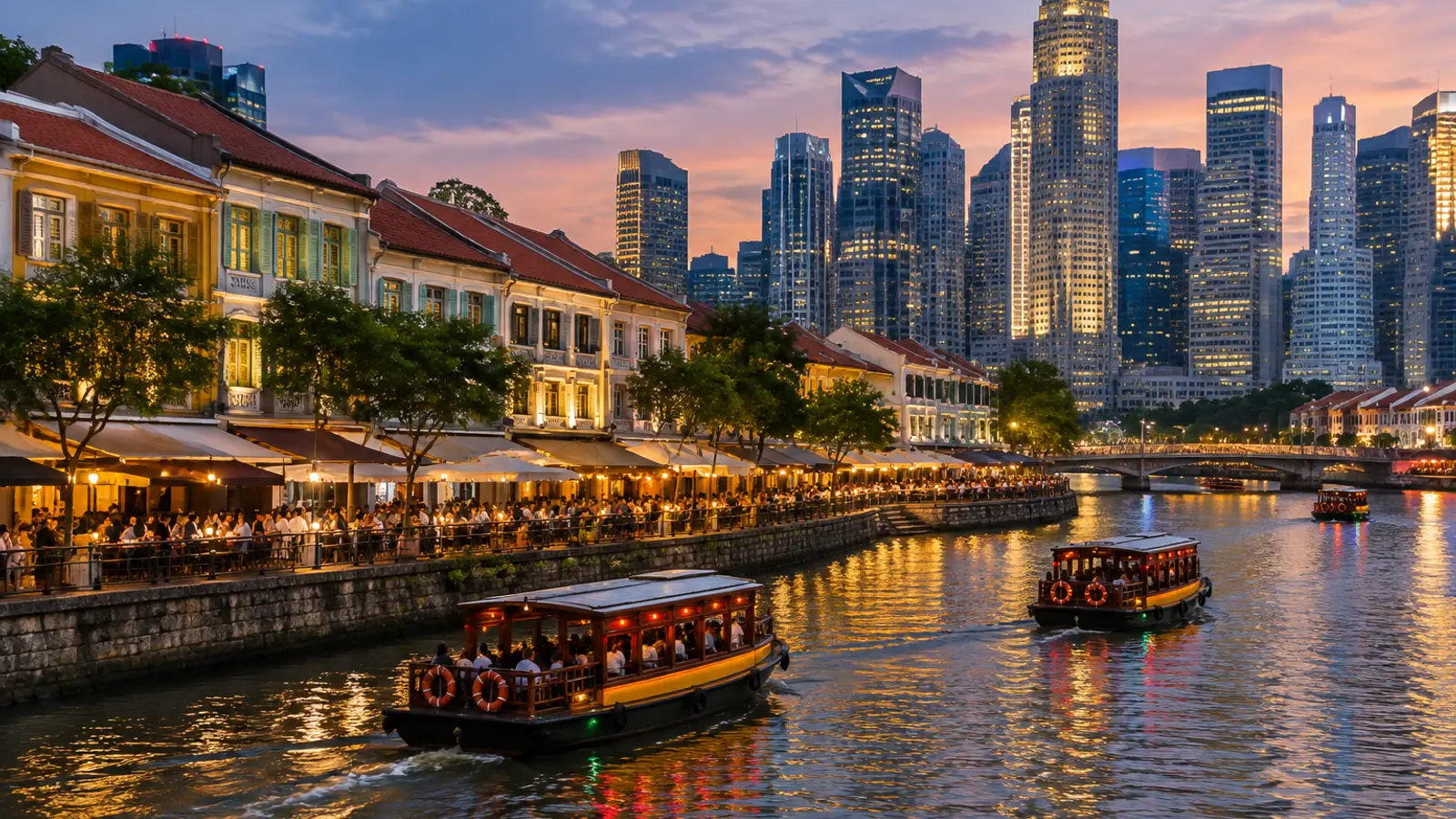
Boat Quay shophouses are a conserved row of narrow, deep buildings on the south bank of the Singapore River, a short walk from Raffles Place. Once the colony's busiest lighterage landing, it is now dominated by riverfront restaurants and bars, with offices upstairs. Value turns on frontage, the riverside licence position, lease structure and conservation compliance.
Editorial review as of 5 November 2026. Related: Boat Quay · D01–02 CBD · all neighbourhoods.
| Postal district | D01 (Raffles Place / Marina), within the CBD planning cluster |
|---|---|
| Nearest MRT | Raffles Place (NS26 / EW14); Clarke Quay (NE5) and Telok Ayer (DT18) are within a longer walk |
| URA conservation status | Within a URA-designated conservation area; one of the historic districts first gazetted for conservation in 1989 |
| Typical building form | Two- and three-storey terrace shophouses with five-foot way, narrow frontage and long plot depth running back from the river |
| Dominant uses | Riverfront F&B on the ground floor and quay-side; offices, bars or storage above; very few residential uses |
| Tenure mix | A mix of freehold, 99-year and 999-year titles across the row; always confirm the title on the Singapore Land Authority records for each lot |
| Setting | South bank of the Singapore River, beside the Raffles Place financial core |
| Foot-traffic profile | Strong weekday lunch and after-work trade from the CBD; evening and weekend tourist trade along the river promenade |
From lighterage landing to dining row: a short history of Boat Quay
Boat Quay is a trading frontage that happens to look like a postcard, and it should be underwritten as one.
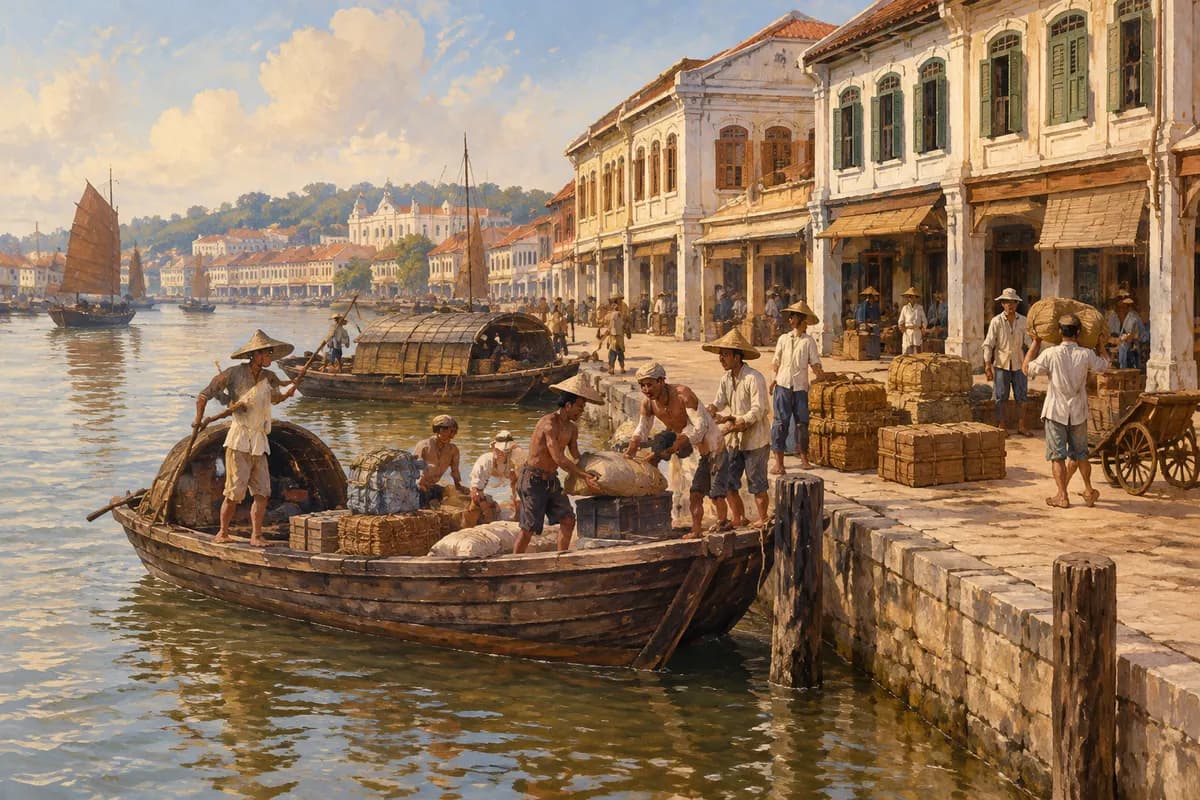
Boat Quay's story begins with the early colonial port. After the 1819 landing of Stamford Raffles, the Singapore River became the commercial artery of the new settlement, and the south bank was allocated to Chinese and other merchants under the 1822 town plan. Cargo arrived by sea in larger vessels moored offshore, then moved up the river on small lighters known as tongkangs. The quay where those boats berthed became Boat Quay.
The shophouses that survive today mostly date from the later nineteenth century and early twentieth century, when traders built long, narrow premises that served two purposes at once. The front onto Boat Quay street carried the shop and office, while the rear opened onto the river for goods to be hauled in and out. Merchants, commission agents and moneylenders worked here, and the row became one of the busiest trading frontages in the colony.
Fortunes shifted in the twentieth century as larger cargo moved to deepwater port facilities and the lighterage trade declined. The river itself became heavily polluted, and a government clean-up of the Singapore River and Kallang Basin ran through the late 1970s and 1980s, relocating boatmen, street hawkers and backyard trades. That clean-up is the hinge in Boat Quay's modern history, because it made the river a place people wanted to be beside rather than avoid.
Conservation followed. Boat Quay was among the first historic districts gazetted for conservation in 1989, alongside areas such as Chinatown, Little India and Kampong Glam. The shophouses were restored, the riverside was opened to the public, and restaurants and bars took over the ground floors. For a wider view of how the CBD fringe developed, see our Chinatown neighbourhood guide and the Boat Quay area page.
Streets, frontage and the physical Boat Quay shophouse stock
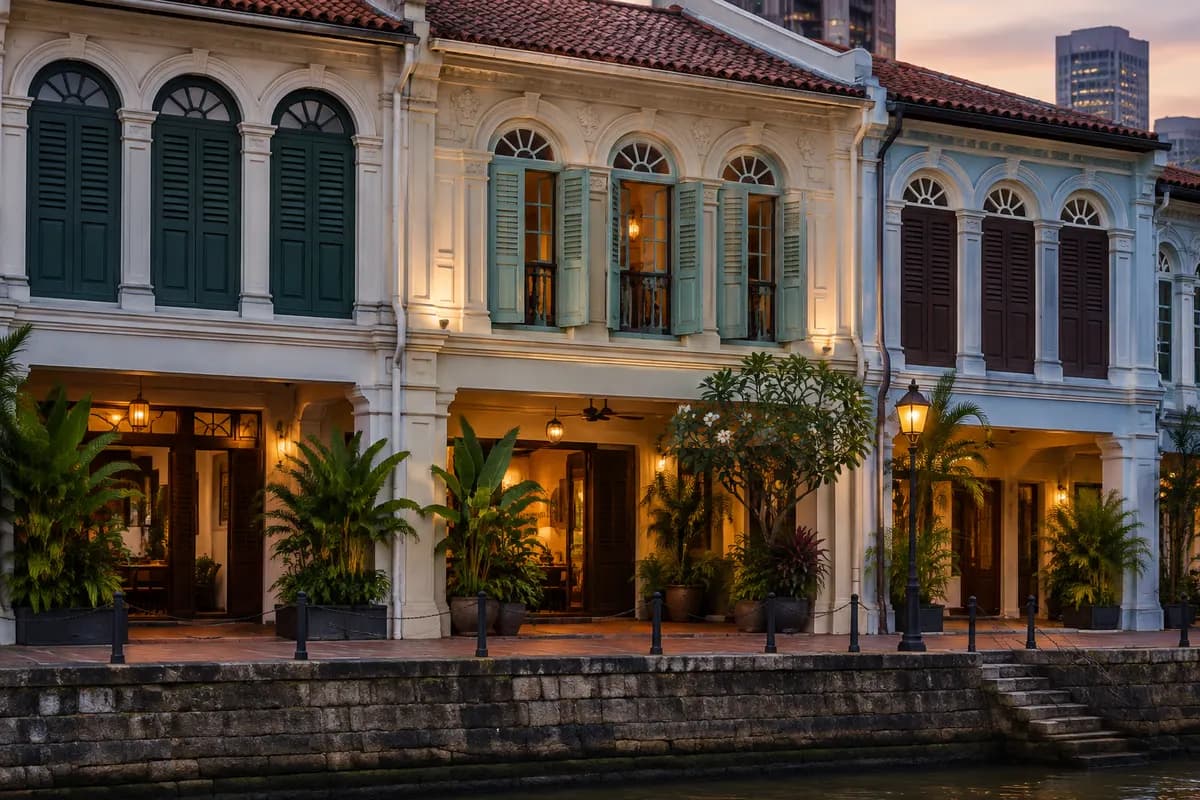
Boat Quay is a compact precinct, essentially one long terrace facing the river with a short back street behind. The road named Boat Quay runs along the shophouse row, and the river promenade lies directly in front of it. The terrace sits between two historic crossings, with Elgin Bridge near one end, so the stock is easy to understand: a single continuous line of party-wall units that front the water.
The unit form is the classic narrow, deep shophouse. Frontages are slim, and the plots run back a long way, which gives a long and sometimes dark interior that must be handled with care in layout and ventilation. Ground floors usually sit behind the five-foot way, a covered pedestrian arcade that is part of the conserved streetscape. Upper floors typically have timber floors and shuttered windows in the Straits Eclectic or late-Victorian idiom.
Many units have been combined, extended or remodelled over time, especially to create wider restaurant floors. Rear sections that once served as godowns on the river side now often hold kitchens, riverside terraces or service areas. Because the conservation framework controls both external appearance and a large share of the building fabric, the modifications you can realistically make today are narrower than those done decades ago.
If you are comparing units, always walk the building front to back and upstairs. Look at the party walls, staircase position, wet areas, roof condition and whether there is a clear back-of-house route. The Singapore River promenade directly in front of the shophouses is a public space, so understand where the lot boundary ends and which frontage areas may be subject to outdoor refreshment rules and approvals.
- Narrow frontage and long depth make layout and natural light the key design constraints.
- The five-foot way is a protected conserved feature and cannot simply be built over.
- River-facing rears and terraces are valuable but sit within rules for outdoor seating and noise.
- Check for earlier amalgamations of adjoining units, which affect structural and fire compliance.
Boat Quay shophouse uses and tenant mix
A Boat Quay shophouse is, first of all, a food-and-beverage and nightlife frontage. The ground-floor and quay-side positions have long been occupied by riverside restaurants, bars and pubs, many with outdoor tables facing the promenade. Whether the menu is ramen, seafood, steakhouse or cocktails, the strip suits dining concepts that rely on visibility, spill-out seating and a mixed clientele of office workers, residents of the nearby CBD and visitors.
Upper floors serve other users. Offices, small professional firms, private members' venues and storage or back-of-house space occupy the second and third storeys in many buildings. Because the quay is within the central business area, the planning classification for most units is commercial rather than residential, which shapes both who can lease the space and how it is financed and taxed. See our guide on commercial versus residential ABSD for how that classification matters to buyers.
Tenant quality and lease length vary a lot. Long-running operators may hold multi-year leases with renewal options, while newer entrants often take shorter terms. The tenant mix also tends to cycle with the broader dining market and tourism, so prospective landlords should look at the covenant strength of the operator, the tenancy history of the unit, and the state of fit-out left behind.
Alternative uses are possible but not automatic. Office, boutique hospitality or specialist retail can all work in principle, but any change of use must be allowed under the prevailing URA planning controls and the conservation guidelines. Our F&B licensing and change-of-use guide sets out the approvals sequence, and it is worth reading before you assume that any unit can be re-let to a different trade.
Riverside restaurant and bar strip: the dining scene at Boat Quay shophouses
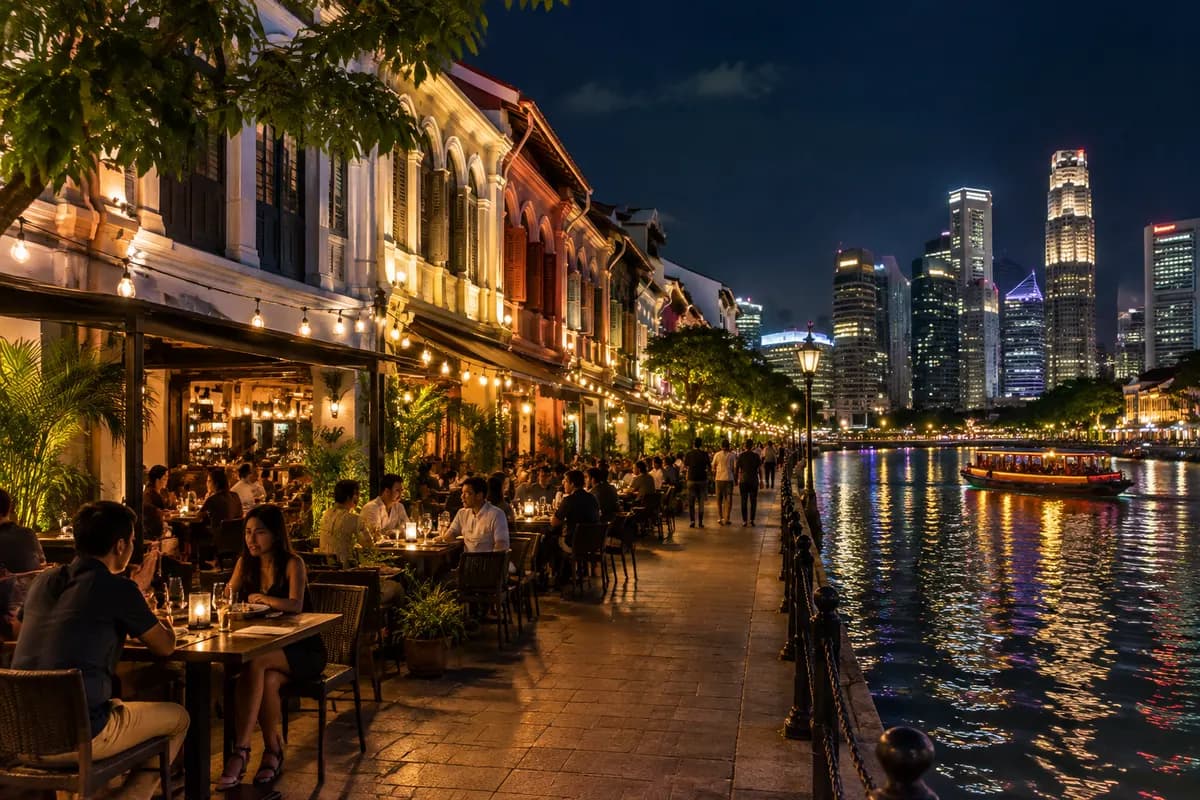
The appeal for operators is straightforward. A river-facing table in the heart of the CBD is a scarce proposition, with strong lunchtime and early-evening footfall from Raffles Place and a promenade that functions as the front garden for the whole row. Operators typically build the business model around alfresco seating, which is the main differentiator from interior-only shophouse restaurants elsewhere in the city.
That same dependence on outdoor seating is also the key commercial risk. Weather, haze, noise complaints and changing outdoor refreshment rules can affect revenue much more than they would for an indoor-only unit. Anyone underwriting a lease should ask how much of the trading area sits outside the lot line, on what authority it is used, and how the licence position could change at renewal.
Retail in the classic sense is limited here. The area is not a shopping street, so retail uses tend to be small, tourism-oriented or ancillary to F&B. For retail-led shophouse strategies, nearby areas with a deeper local shopper base, such as Jalan Besar or Little India, behave very differently from a dining-and-drinking quay.
URA conservation status and what the guidelines mean here
Boat Quay lies within a URA conservation area, and its shophouses were among those protected when the first conservation areas were gazetted in 1989. Conservation status brings two consequences for owners. First, the exterior and a considerable portion of the original structure are controlled, so façades, roof forms, shutters, windows, the five-foot way and similar features are expected to be retained or restored faithfully. Second, any works need approvals before they begin.
In practice, owners should treat the URA conservation guidelines as a design brief rather than a hurdle at the end. Façade restoration, roof repairs, structural works, additions at the rear and changes to the interior layout are all subject to controls that depend on the category of the building and the area. Our full URA conservation guidelines buyer manual walks through these categories and the process.
A buyer's checklist should include confirming the exact conservation category for the lot, obtaining the approved plans history, checking for unauthorised alterations, and engaging a conservation-experienced architect and qualified person early. The practical effect of conservation is that quality, compliant restorations often command attention from tenants and buyers, while problem units with unapproved works carry additional uncertainty.
Conservation also affects timing. Approvals and restoration works take time, and a unit that needs significant works before it can be let or sold should be priced and financed with that in mind. For a broader walk-through of the buying side, read investing in Singapore conservation shophouses.
MRT, transport and walkability
Boat Quay's best transport asset is its adjacency to Raffles Place. Raffles Place MRT (NS26 on the North-South Line and EW14 on the East-West Line) is a short walk from the quay, which puts the row on a major interchange with direct access across the CBD and to the wider network. Other nearby stations include Clarke Quay (NE5, North East Line) on the upstream side and Telok Ayer (DT18, Downtown Line) towards the Chinatown side.
On foot, the area connects naturally in several directions. Cavenagh Bridge and Elgin Bridge lead across the river towards the civic district and the Padang area, while Chinatown and Telok Ayer lie a few minutes' walk to the south and west. The riverside promenade continues upstream towards Clarke Quay, which makes a pleasant evening circuit for visitors and diners.
Vehicle access is more constrained. The quay frontage is largely pedestrian-oriented, and operators rely on controlled loading arrangements for deliveries and servicing. When assessing a unit, check how stock reaches the premises, where refuse is collected, and what the realistic servicing hours are. Back-of-house logistics are a quiet determinant of whether a restaurant unit actually works.
- Raffles Place (NS26 / EW14): the primary station for the quay and the CBD.
- Clarke Quay (NE5): upstream, reachable by riverside walk.
- Telok Ayer (DT18): toward the Chinatown and Telok Ayer shophouse belt.
Price and rent context: how Boat Quay is positioned, without quoting figures
Editorial review as of 5 November 2026; no figures quoted here—verify current transactions. Boat Quay is generally regarded as one of the most visible, tourism-facing shophouse frontages in the CBD, with value driven by river views, the outdoor seating position, proximity to the financial district and the scarcity of comparable riverfront stock. It tends to be priced and let as a commercial trading frontage rather than as a lifestyle or residential asset.
Because units differ so much in depth, frontage width, state of restoration, tenure, outdoor-area rights and existing lease, headline averages say little about any individual building. A well-restored freehold unit with a strong tenant is a different instrument from a leasehold unit needing works. Rely on unit-level evidence, not area-level rules of thumb.
Use the table below as a research plan. Each row names the data point you need, where to find it, and why it changes the valuation conversation. Do not rely on a broker's quoted comparables alone; cross-check against registered transactions and official statistics.
| What to benchmark | Where to find it | Why it matters |
|---|---|---|
| Recent caveated or registered transactions for nearby shophouses | URA REALIS (subscription) or URA SPACE; SRX or EdgeProp transaction listings | Shows what comparable buildings actually changed hands for, rather than asking prices |
| Land tenure and title details | SLA title search (Singapore Land Authority); your lawyer's conveyancing search | Freehold, 99-year and 999-year titles value differently, and remaining lease matters |
| Rental benchmarks for commercial and office space nearby | URA rental statistics for shop space and office space; EdgeProp and SRX rental listings | Indicates whether in-place rent is at, above or below market and what renewal might look like |
| Current tenancy terms for the target unit | Tenancy agreement and rent roll provided in due diligence | Lease length, rent reviews and covenant strength drive income security |
| Property tax and annual value | IRAS property tax enquiry for the specific address | Non-owner-occupied property tax is a real running cost and affects net yield |
| Stamp duty and ABSD treatment | IRAS stamp duty pages; our commercial vs residential ABSD guide | Classification and buyer profile change upfront cost materially |
The investment angle: scarcity, income and what can go wrong
The investment case for Boat Quay rests on scarcity and location. The row is a finite, protected stock with a riverfront setting beside the financial district, which cannot be replicated by new development. Operators value it for traffic and visibility, and long-term owners value it for the conserved character and the strategic location.
The counterweights are equally real. Income is tied to F&B tenants whose fortunes follow dining and tourism cycles. Outdoor seating dependence creates operating risk. Conservation compliance imposes cost and timing constraints on works. And the narrow, deep form limits how flexibly a unit can be repurposed. Underwrite on conservative occupancy and rent assumptions, with a margin for refurbishment.
Tenure and classification are central. Review our freehold shophouses guide for how title type influences long-run value, and the commercial vs residential ABSD breakdown for the stamp duty effect of purchasing commercial-zoned shophouses. Browse live opportunities in commercial shophouses for sale and conservation shophouses for sale.
Buying checklist for a Boat Quay shophouse
A disciplined checklist protects you from the most common surprises. Start with title and planning: confirm tenure, the zoning and permitted uses, and the conservation category. Then move to the building: structural condition, roof, party walls, drainage, fire safety, and whether the existing alterations were approved. Finally, assess the commercial side: lease terms, tenant covenant, licences and any outdoor seating arrangements.
Commission specialist advice before you commit. A conservation-experienced architect, a structural engineer and a property lawyer familiar with shophouse transactions should each review their part. Ask your lawyer specifically about easements, party-wall rights, any state or agency interests over river-facing areas, and the treatment of outdoor refreshment areas in the lease.
Model the financing and tax early. Commercial property loans differ from residential loans in tenor and loan-to-value, and stamp duties differ by classification. Run the numbers for a full holding period including vacancy, restoration capex and property tax, rather than relying on the current rent alone.
- Verify title, tenure and conservation category before paying an option fee.
- Obtain approved plans and check for unauthorised works.
- Review the tenancy: term, rent reviews, security deposit and licence position.
- Inspect structure, roof, drainage and fire safety with qualified professionals.
- Confirm what is inside and outside the lot line for outdoor seating.
- Model stamp duty, financing cost and property tax under your buyer profile.
Renting a unit at Boat Quay: what tenants should check
For operators, the first question is whether the premises are approved for the intended use. F&B needs the right planning approval, food-shop licensing and compliance with fire and ventilation requirements, and not every unit is configured to pass. Ask the landlord for the approved use, the last licence in place, and any outstanding conditions.
Next is the outdoor area. If your business case includes tables on the promenade or quay-side, clarify in writing what the landlord can and cannot grant, who holds the approval, what happens if it is withdrawn, and whether the rent reflects the outdoor component. Seek lease protections such as a rent abatement if outdoor seating becomes unavailable.
Fit-out and reinstatement obligations deserve negotiation. Conservation buildings limit what you can alter, and reinstatement clauses can become expensive. Browse current availability through the shophouses for rent hub and compare lease structures across several units before you commit.
Risks specific to Boat Quay
Concentration risk is the first to name. The row depends heavily on riverfront F&B and tourism, so a downturn in either affects several buildings at once. Operator turnover can leave units vacant with costly fit-outs, and well-known strips sometimes have rent expectations that outrun trading performance.
Regulatory and environmental risks are second. Outdoor seating rules, noise controls and the proximity of residential and hotel uses nearby can all change the operating environment. The riverside setting also brings flood-management and maintenance considerations, and older timber and masonry fabric needs ongoing care.
Finally, there is liquidity risk. Whole shophouses are lumpy assets with a narrow buyer pool, and sale timelines can be long. Plan an exit strategy at purchase, including whether the likely buyer is an owner-operator, a family office or an investor, and what condition the building must be in to appeal to them.
Clarke Quay adjacency and other nearby areas
Boat Quay sits in a dense cluster of heritage districts. Upstream along the river, Clarke Quay offers a more master-planned entertainment precinct. To the south, Chinatown and Telok Ayer mix temples, offices and boutique hospitality, while Tanjong Pagar is a stronger lifestyle and dining belt on the CBD fringe.
Compared with those areas, Boat Quay is the most singularly river-oriented and the most dependent on a single trade. If you want a more residential-leaning or creative-use mix, consider Kampong Glam or the area pages for Tanjong Pagar and Telok Ayer. Reviewing several clusters side by side is the best way to understand what you are really paying for at the quay.
Sources
Frequently Asked Questions
Are Boat Quay shophouses freehold?+
Tenure is mixed across the row, so there is no single answer. Individual lots may be freehold, 99-year leasehold or 999-year leasehold. Always confirm the exact tenure and remaining term through an SLA title search and your lawyer before relying on any listing description.
Are Boat Quay shophouses conserved?+
Yes. Boat Quay lies within a URA conservation area and was among the first historic districts gazetted for conservation in 1989. Façades and much of the original fabric are controlled, and works need prior approval from the relevant authorities.
Which MRT station is closest to Boat Quay?+
Raffles Place MRT (NS26 / EW14) is the closest and most convenient. Clarke Quay (NE5) is reachable on foot along the river, and Telok Ayer (DT18) is within walking distance towards Chinatown.
Can I live in a Boat Quay shophouse?+
Generally not as a standard arrangement. The row is oriented to commercial use, mainly F&B and offices, within the central business area. Permitted uses are set by URA planning controls for each lot, so check the approved use before assuming residential occupation is allowed.
Is ABSD payable on a Boat Quay shophouse purchase?+
It depends on the classification of the property. Purely commercial shophouses are treated differently from residential-zoned or mixed-use properties for ABSD. Check the current IRAS rules and our commercial vs residential ABSD guide, and have your lawyer confirm for the specific lot.
What are Boat Quay shophouses mainly used for?+
Riverfront restaurants and bars dominate the ground floors, with offices and back-of-house space on upper floors. Any change of use requires approval and must be consistent with conservation guidelines, so confirm what the specific unit is approved for.
Is a Boat Quay shophouse a good place for a restaurant or bar?+
It can be, because the riverside strip draws lunch, after-work and tourist dining trade. Success depends on the unit's approved F&B use, ventilation and licensing, outdoor seating rights and lease terms, so confirm each before committing to any cuisine or concept.
How close are Boat Quay shophouses to Clarke Quay?+
Both sit on the Singapore River and are linked by the riverside promenade, so a walk between them is short. Boat Quay is a row of individually held shophouses, while Clarke Quay is a more managed entertainment precinct.
How do I check current Boat Quay prices and rents?+
Use registered transaction data from URA REALIS or URA SPACE, listing data from SRX or EdgeProp, and URA rental statistics for shop and office space. This page quotes no figures, so verify current transactions for the specific building before any decision.