
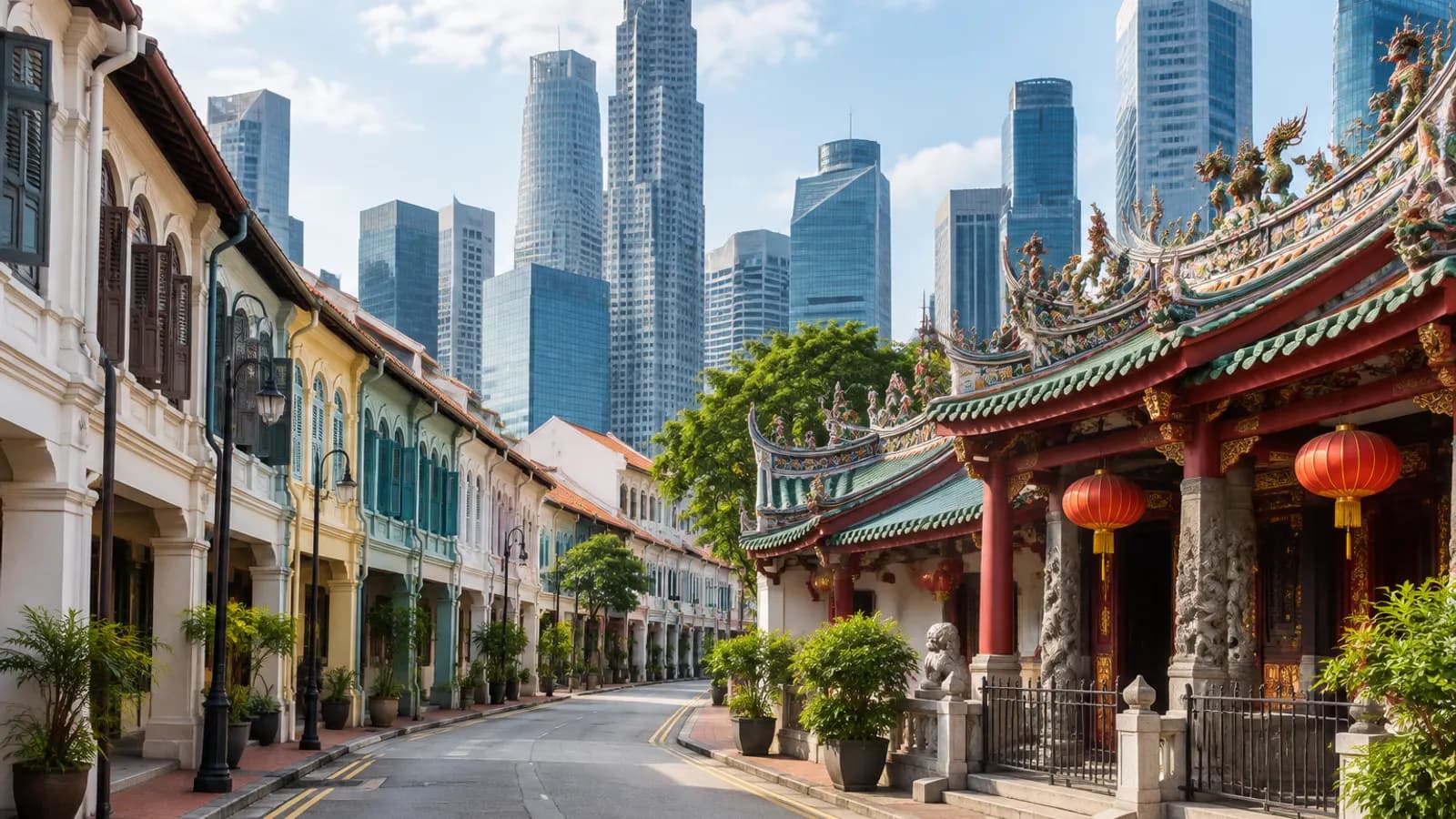
D01–02 (Telok Ayer, Central Region, at the edge of the CBD) · Neighbourhood guide
Telok Ayer shophouses
A Telok Ayer shophouse is a conserved terrace on the old shoreline street: heritage temples and mosques, Amoy Street lanes and offices minutes from Raffles Place.
A Telok Ayer shophouse sits on a CBD-edge heritage street that originally ran along Singapore's shoreline and is known for Thian Hock Keng, Al-Abrar Mosque and Nagore Durgha Shrine. Its conserved shophouses suit offices, restaurants and boutique hospitality, backed by Telok Ayer and Raffles Place MRT. Buyers face strict URA conservation controls and must verify tenure and authorised use lot by lot.
Editorial review as of 5 November 2026. Related: Telok Ayer · D01–02 CBD · all neighbourhoods.
| Postal district | D01–02 area at the southern edge of the CBD |
|---|---|
| MRT stations | Telok Ayer (DT18 Downtown Line); Raffles Place (NS26 / EW14); Downtown (DT17); Chinatown (NE4 / DT19) and Tanjong Pagar (EW15) nearby |
| URA conservation status | Conservation shophouses along Telok Ayer Street and neighbouring lanes sit within URA's conservation framework, which began with the 1989 first conservation areas; confirm each lot on the URA map |
| Typical building form | Two- to three-storey shophouses plus religious and institutional heritage buildings; mixed styles |
| Typical uses | Offices, restaurants, bars, cafes, boutique hospitality, professional services, small retail |
| Tenure mix | Freehold, 99-year, 999-year and State leases all occur; verify by title search |
| Key streets | Telok Ayer Street, Amoy Street, Ann Siang Hill and Ann Siang Road, Cross Street, Boon Tat Street |
| Landmarks | Thian Hock Keng Temple, Nagore Durgha Shrine, Al-Abrar Mosque, Fuk Tak Chi Museum, Lau Pa Sat, Telok Ayer Green |
History: the Telok Ayer shophouse street at the water's edge
Telok Ayer is the one heritage street where the temples, the shoreline story and the CBD towers all meet.
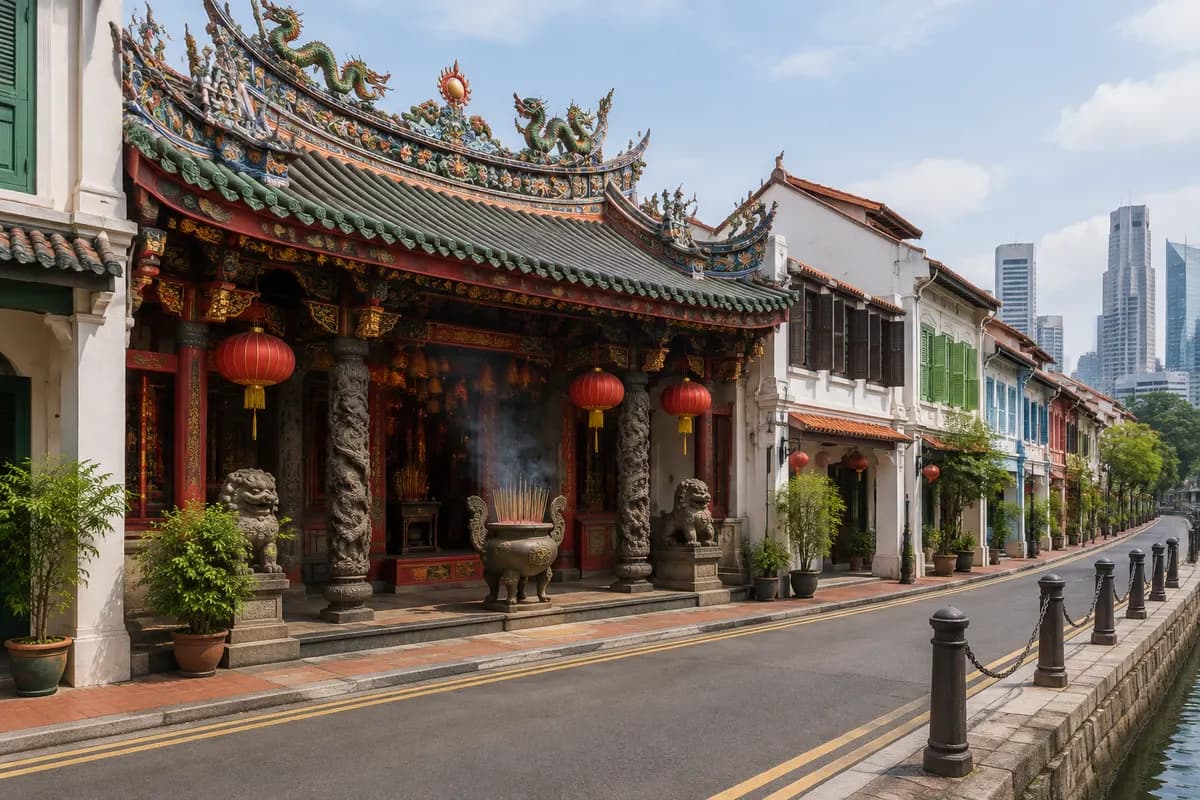
Telok Ayer means water bay in Malay, and the name is a reminder that the street once ran along the sea. Before large-scale land reclamation pushed the coastline outward, boats from China and the region landed migrants and goods close to this line. That made Telok Ayer Street one of the earliest points of arrival for the Chinese community in nineteenth-century Singapore.
Gratitude shrines followed arrivals, so places of worship were built facing the sea. Thian Hock Keng, a Hokkien temple dedicated to Mazu, protector of seafarers, was completed in the early 1840s and became the best-known of them. Close by, the Nagore Durgha Shrine and the Al-Abrar Mosque reflect the Indian Muslim community that also traded and worshipped here.
The shoreline later moved away through reclamation, and the district's role changed from landing point to commercial edge of the growing business centre. The old Telok Ayer Market, now called Lau Pa Sat, is a Victorian cast-iron structure that survives as a food centre. Conservation policy from 1989 onward helped keep the street's scale and religious landmarks intact beside the glass towers of Raffles Place.
Key streets and shophouse character
Telok Ayer Street is often described as one of the most architecturally varied streets in the CBD edge, because the frontages reflect different eras of rebuilding. Some buildings keep the modest proportions of the early terraces, while others carry the more decorative facades of later decades. That variety is part of the charm, but it also means no two buildings have the same conservation story.
Telok Ayer Street is the spine. Its shophouses are interspersed with temples, mosques and clan buildings, so a walk along it is as much a lesson in religious pluralism as in architecture. The Fuk Tak Chi Museum, housed in a former temple, and Telok Ayer Green add small public spaces that break up the street wall.
Amoy Street, parallel to the south-west, is a compact run of conserved shophouses with a lunch-driven food scene and a sizeable stock of small offices. Ann Siang Hill rises behind, with terraces climbing the slope and a park at the top, and it blends into the Club Street and Ann Siang Road dining zone that borders Chinatown.
Cross Street and Boon Tat Street connect the heritage pocket to the financial towers, which explains the strong weekday footfall. Because the terraces are interrupted by religious buildings and modern infill, the heritage quality of individual blocks varies, and each lot should be examined on its own merits.
- Telok Ayer Street: heritage temples, mosques and shophouse dining.
- Amoy Street: office-supporting food and small professional tenants.
- Ann Siang Hill and Ann Siang Road: terraces, bars, studios and a hillside park.
- Cross Street and Boon Tat Street: connectors to Raffles Place and Lau Pa Sat.
Architecture and the religious heritage next door
Shophouses here are narrow-fronted terraces with deep floor plates, timber shutters, decorative tiles and a covered five-foot way. Styles range across the conservation periods, and some frontages were altered over the decades. The result is a streetscape that feels layered rather than uniform.
Living beside nationally significant religious buildings brings its own considerations. Worship activity, festivals and processions can affect noise, access and loading on certain days. Sensible tenants treat that as part of the street's character, and landlords should plan lease clauses accordingly.
Building condition is a decisive variable. Older timber elements, rising damp, aged wiring and fire-safety retrofits all require attention. Engage a conservation architect and an MEP engineer who have worked on terrace shophouses before committing.
Uses and tenant mix
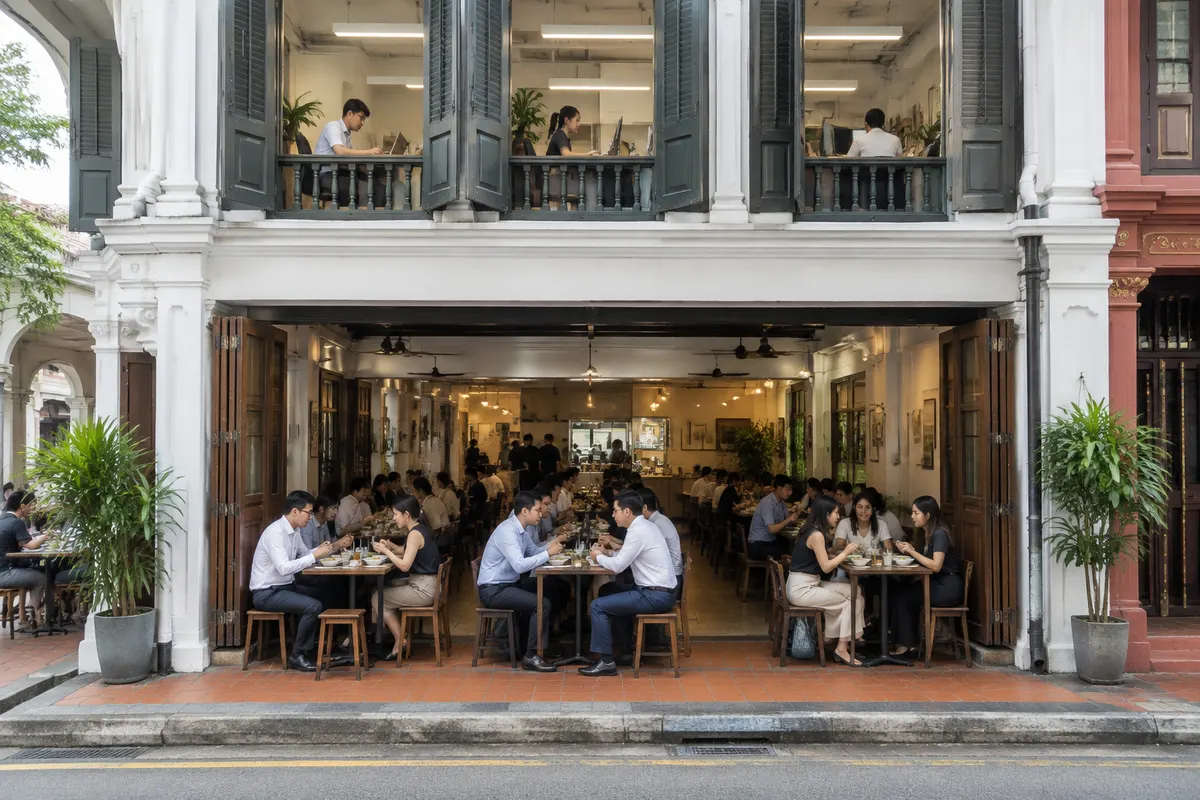
A simple test for a Telok Ayer building is to ask who would pay for it and why. An office tenant pays for address, character and walking distance to clients. A restaurant operator pays for lunch volume. A boutique hotel or serviced-stay operator pays for the uniqueness of a conserved interior. Each of these buyers of space has a different appetite for fit-out cost and a different tolerance for building quirks, and the strongest landlords match the building to the right tenant type.
Telok Ayer is the most office-oriented of the three CBD-edge heritage pockets. Law, consulting, design, technology and finance-adjacent firms use upper floors, valuing the character and the short walk to Raffles Place. Whole-building occupiers often run an office above and a cafe or restaurant below.
Hospitality is the second pillar. Restaurants, wine bars and boutique hotels or serviced stays occupy conserved frontages, particularly on Telok Ayer Street and towards Ann Siang. These tenants want an evening trade that supplements the weekday lunch crowd.
Because office and F&B use both occur, authorised use is the key diligence item. A change from office to F&B on a given storey typically needs planning approval and licensing, and a buyer should not assume the existing mix is lawful in every respect.
Telok Ayer accounting firm shophouse and office conversions
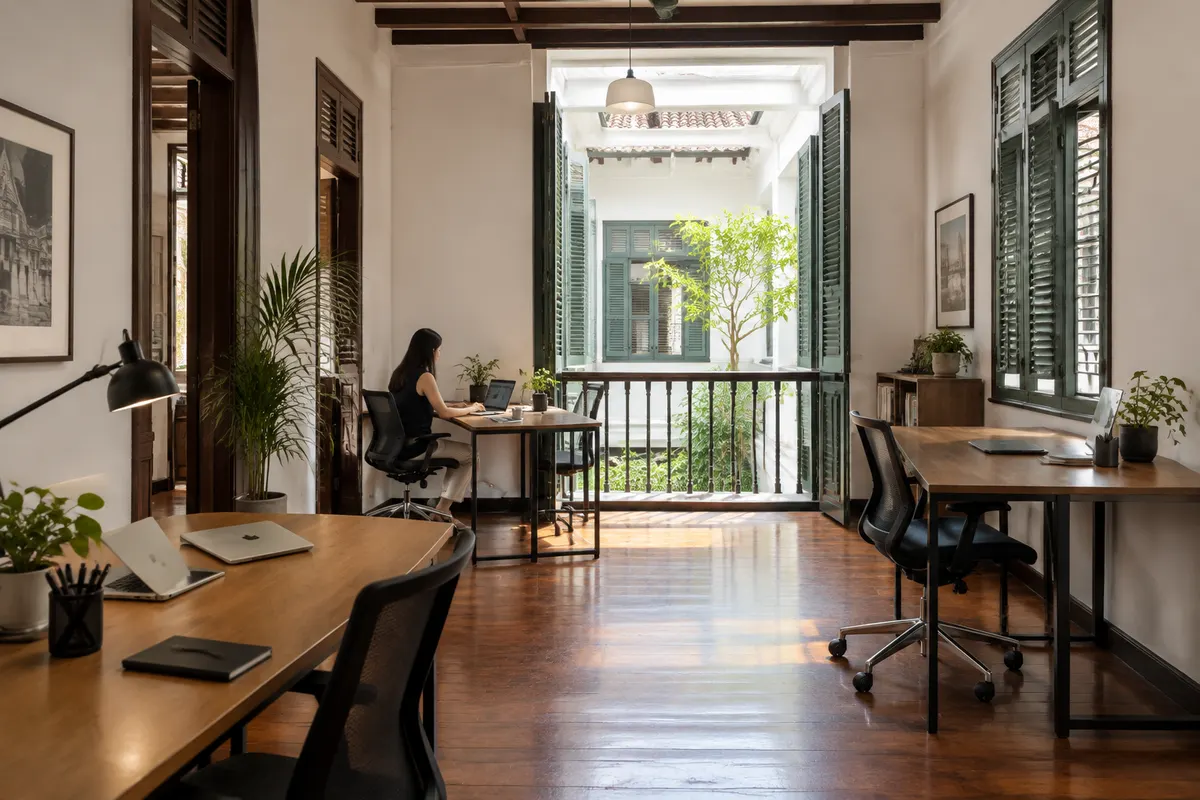
Small professional practices, including accounting, tax, legal and advisory firms, are a natural fit for a Telok Ayer accounting firm shophouse arrangement. They value an address near Raffles Place, a client-friendly environment that feels more personal than a tower lobby, and floor plates that suit small teams. A whole shophouse can house reception, meeting rooms and partners' offices across two or three storeys, with an informal ground-floor presence.
Office conversion of a conserved shophouse is a design and compliance exercise. Interior partitions, ceilings, air-conditioning, data cabling and acoustic treatment must work around retained timber, staircases and the air well. Fire-safety measures, such as escape routes, fire-rated separation and detection, are often the most constraining elements in a narrow, deep building, and a qualified person should confirm feasibility early.
Authorised use again decides the outcome. An upper floor approved as residential or storage is not automatically approved as office, and the reverse is also true. A buyer or tenant planning a conversion should secure approvals or a clear written route to them before committing. Read the URA conservation guidelines buyer manual for the process.
For firms that need meeting space and visibility, a ground-floor client area with discreet signage within conservation rules can work well. Rented offices should also plan for staff amenities, since small buildings lack the lifts, lobbies and shared facilities of a tower.
Amoy Street conservation shophouses next door
Amoy Street conservation shophouses form the parallel street to Telok Ayer Street and share the same walking catchment, MRT access and tenant profile. For many buyers and tenants, the two streets are one decision: they compare frontage, condition and price across both. Amoy Street is generally the more lunch-and-office-led of the two, while Telok Ayer Street adds the heritage-landmark character.
If you are comparing, ask about service access, back lanes, and the relationship between the shophouse and its neighbours, since Amoy Street has a mix of conserved terraces and newer buildings. See our Tanjong Pagar neighbourhood page for the Amoy Street shophouse for sale and office-use angle in more detail.
F&B and retail scene
The weekday lunch peak is intense and short. Operators typically need fast service, efficient kitchens and compact menus to capture it, and the small floor plates of a shophouse reward that discipline. Evening and weekend trade is less predictable and is often supported by bar offerings, reservations and events. Because so many tenants compete for the same limited window, location within the street, visibility from the MRT exit and walking time from office lobbies can matter as much as the rent.
Lunch is Telok Ayer's engine. Amoy Street, Telok Ayer Street and the Lau Pa Sat area feed large numbers of CBD workers, and cafes and casual restaurants dominate. After work, bars and dinner venues take over, with Ann Siang Hill and Club Street providing additional evening capacity.
Retail beyond food is modest. Specialist shops, galleries and service businesses exist but depend on the same office and visitor streams. The visitor flow to the temples and Lau Pa Sat adds some weekend and tourist trade, though less than Chinatown's market streets.
For operators, the usual rules apply: small kitchens, exhaust routing, neighbour sensitivity and approvals. See the F&B licensing and change-of-use guide for the sequence.
URA conservation status and practical limits
Singapore's conservation programme began in earnest with the 1989 gazette of the first conservation areas, and the shophouses along Telok Ayer Street and its neighbouring lanes are protected under URA's conservation framework. Because the exact boundaries and categories differ from lot to lot, confirm status on URA's online tools rather than relying on a listing description. The URA conservation guidelines buyer manual walks through the checks.
In practice, facades, roof forms and key features must be conserved, and works require approval. The streetscape's value to tenants and visitors is a direct product of those rules, which is both a protection and a constraint for owners.
Places of worship and other nationally significant heritage buildings on the street may be subject to additional protection or specific controls. They are not shophouses for sale, but they shape what is practical next door.
Transport and walkability
Network position is a quiet strength. Raffles Place is an interchange between the North South and East West lines, and Telok Ayer and Downtown stations add Downtown Line services toward Bugis, Little India and Chinatown. For a tenant, that means a wide catchment of staff and customers, and several ways to reach the building if one line is disrupted. For an investor, it supports long-run demand because accessibility is a permanent attribute of the location.
Telok Ayer MRT (DT18) on the Downtown Line sits on the street itself. Raffles Place (NS26 and EW14) is a short walk north-east and provides the North South and East West lines, while Downtown (DT17) and Chinatown (NE4, DT19) extend the choices. Tanjong Pagar (EW15) is reachable on foot from the southern end.
Few heritage addresses in Singapore are as close to a financial hub. That gives office tenants fast access to clients and staff, and gives F&B operators a captive weekday population.
Streets are walkable but busy at lunch. Delivery windows, rubbish collection and taxi pick-ups are practical issues on narrow lanes, so test them at your own operating hours.
Price and rent context
Telok Ayer shophouses are positioned as heritage buildings priced in the shadow of the CBD. The proximity to Raffles Place anchors demand, while conservation limits supply. Tenure, building size, approved use and how readily the building can be let as a whole are the main value drivers.
Because buildings along Telok Ayer Street and on Amoy Street or Ann Siang Hill differ in frontage, condition and neighbours, a single average is misleading. Compare like for like, and weigh whether the income is office-led, F&B-led or mixed.
Editorial review as of 5 November 2026; no figures quoted here—verify current transactions.
| What to benchmark | Where to find it | Why it matters |
|---|---|---|
| Completed shophouse transactions | URA REALIS and URA SPACE | Provides comparable deal evidence rather than asking prices |
| Listings and asking levels | SRX and EdgeProp | Shows live expectations and time on market |
| Office and retail rents | URA rental statistics | Benchmarks upper-floor office versus ground-floor retail rent |
| Annual value and property tax | IRAS | Determines holding cost and net income |
| Title, tenure and caveats | Singapore Land Authority (SLA) | Confirms freehold or leasehold and any encumbrances |
Investment angle
A practical way to frame the Telok Ayer investment is by asking what happens at lease expiry. If the building is let to a single office tenant, renewal depends on that business's health and the CBD office market. If it is let to F&B operators, renewal depends on trading performance. A landlord with a diversified tenant base across floors tends to have smoother income, but may carry more management work and more varied compliance obligations.
The investment case combines workplace demand, heritage scarcity and a hospitality tail. Buildings that can be let to an office occupier with a ground-floor food tenant are the classic pattern. Our investing in conservation shophouses guide covers return drivers and downside cases.
Structure and tax matter as much as location. Read the commercial vs residential ABSD breakdown before choosing an entity or use, and the freehold shophouses guide to understand how tenure affects value. Browse commercial shophouses for sale and conservation shophouses for sale for live stock.
Model realistic downtime. An office tenant leaving can leave a building empty for a period, and re-fitting a conserved interior is rarely cheap. Remember also that income streams depend heavily on the strength of the CBD office market.
Lau Pa Sat, Ann Siang Hill and the pull of the neighbours
Telok Ayer's shophouses benefit from landmark neighbours that draw people without any effort from the individual tenant. Lau Pa Sat, the restored Victorian market building, attracts office workers and visitors every day. Thian Hock Keng and the neighbouring shrines draw heritage visitors, school groups and worshippers, and the park on Ann Siang Hill adds a green outlook.
These draws shape which sub-pockets are strongest. Lots within an easy walk of the MRT and the market tend to have better footfall than those at the quieter ends, and lots near the Ann Siang and Club Street dining strip benefit from evening traffic. A buyer can map these flows by walking the streets at lunch, early evening and late night.
The corollary is that a street's reputation can change. A new restaurant cluster, a new office tower or a change in pedestrian routes can shift where footfall concentrates. Look at recent openings and closures, and talk to existing tenants before assuming that what worked last year will keep working.
For landlords the lesson is to keep flexibility. A building that can be let either as one office occupier or as a split F&B and office arrangement is more resilient than one locked into a single format by its layout or approvals.
Fit-out, reinstatement and lease structuring
Fit-out in a conserved shophouse is rarely straightforward. Any new partition, kitchen, mechanical plant or signage must respect conservation rules and fire-safety requirements, and approvals can take weeks or months. Tenants should confirm in the lease who is responsible for obtaining approvals and for bearing the cost.
Reinstatement clauses deserve attention. A tenant who removes a modern fit-out at lease end may be required to return the space to a stated condition, and in a conserved building that may include repairing historic finishes. Negotiate a clear schedule of condition at the start.
Rent-free periods, fit-out contributions and break rights are all negotiable, and their value depends on the building's condition and the tenant's strength. Seek legal advice on the lease and, for a purchase, on how existing leases affect value and vacant possession.
Buying and renting checklist
Work down the checklist in order, and do not let a charming facade skip the diligence. Prospective tenants can begin with shophouses for rent and apply the lease items below.
- Run an SLA title search for tenure, owners and caveats.
- Confirm conservation status and authorised use storey by storey.
- Check fire-safety compliance, escape routes and the status of any air well.
- Inspect roof, damp, termites and electrical capacity.
- Review leases for rent reviews, reinstatement and signage rights.
- Ask how festivals and religious events on the street affect access.
Risks and nearby areas
Liquidity and valuation are underappreciated risks. Few conserved shophouses change hands in any year, and each differs in tenure, size and condition, so valuers rely on a thin pool of comparables. Selling may take longer than for standardised property, and pricing can be negotiated more on the building's story than on a formula. Buyers should assume a long holding period and avoid leverage that forces a sale at a poor moment.
Office-cycle exposure is the principal risk, followed by building age and approvals. A concentrated tenant base in one sector can magnify vacancies, and conserved buildings take time and money to refit. Event days near places of worship can also affect trade and access.
Compare Telok Ayer with Tanjong Pagar for a more dining-led terrace market, Chinatown for visitor-driven streets, and Boat Quay and Clarke Quay for river-front nightlife. Outside the CBD fringe, Kampong Glam, Little India, Jalan Besar and Geylang offer other conservation markets. See also the Telok Ayer area page.
Sources
Frequently Asked Questions
Is a Telok Ayer shophouse suitable for an accounting firm?+
Often yes. Small professional firms use upper floors for offices near Raffles Place, provided the storeys are approved for office use and fire-safety and conservation requirements are met.
How do Amoy Street conservation shophouses compare with Telok Ayer Street?+
They share an MRT and office catchment. Amoy Street is more lunch-and-office-led, while Telok Ayer Street adds temples and mosques as heritage landmarks. Compare frontage, condition and authorised use.
Why is it called Telok Ayer?+
Telok Ayer means water bay in Malay. The street originally ran along the shoreline before land reclamation moved the coast outward.
Which MRT station serves Telok Ayer?+
Telok Ayer station (DT18) on the Downtown Line. Raffles Place (NS26, EW14), Downtown (DT17), Chinatown (NE4, DT19) and Tanjong Pagar (EW15) are also within walking distance.
Are Telok Ayer shophouses conserved?+
Shophouses along Telok Ayer Street and nearby lanes are protected under URA's conservation framework, which began with the 1989 first conservation areas. Confirm each lot on URA's map.
What are the main uses of Telok Ayer shophouses?+
Offices on upper floors, with restaurants, cafes and bars at street level. Some are boutique hospitality or professional-services premises.
Is Telok Ayer more office-led than Chinatown?+
Generally yes. Its closeness to Raffles Place gives it a weekday office and lunch profile, whereas Chinatown leans toward visitor retail and tourism.
How do I find current Telok Ayer prices and rents?+
Use URA REALIS and URA SPACE for transactions, URA rental statistics for rents, and SRX or EdgeProp for listings. This page deliberately quotes no figures.